Blue-Collar Employee Retention: How AI + WhatsApp Cuts Frontline Attrition by 40%
Here's the math that keeps HR leaders in manufacturing, logistics, and retail awake at night.
The average cost of replacing a single frontline worker in India — factoring in recruitment, onboarding, training, and productivity loss — ranges between ₹15,000 and ₹50,000. For a large manufacturing company with 10,000 frontline workers experiencing 60 per cent annual attrition, that's 6,000 replacements per year. At ₹25,000 per replacement, the annual attrition cost is ₹15 crore.
Globally, deskless worker churn reaches as high as 500 per cent across certain sectors. The Boston Consulting Group found that deskless workers satisfied with their jobs are 62 per cent less likely to consider new employment.
The irony: most blue-collar workers don't leave because of pay. They leave because they feel invisible, unsupported, and disconnected. The exit interview reveals the same themes: "Nobody told me what was happening." "I never received proper training." "I didn't feel like I belonged here."
Why Traditional Retention Strategies Miss the Frontline
Engagement surveys don't reach them. Email-based surveys assume email access. Both assumptions fail for workers who lack corporate credentials.
Career conversations don't happen. When the supervisor-to-worker ratio is 1:50, individual career development conversations are a luxury that never materialises.
Recognition is invisible. The Slack shoutout and email kudos don't reach the contract worker at a remote site.
Training is inadequate. Traditional LMS platforms achieve 20–30 per cent completion rates with frontline workers.
Related reading: Why Frontline Workers Don't Complete Training (It's Not What You Think)
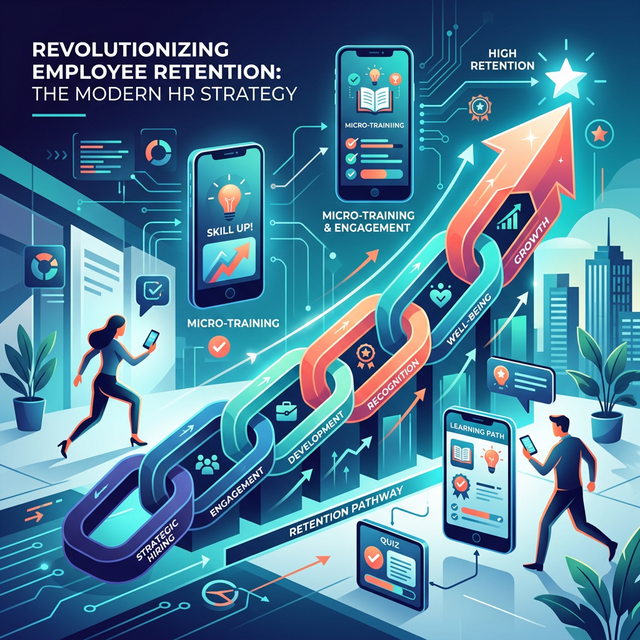
The Four Levers of WhatsApp-Based Retention
Lever 1: Structured Onboarding That Prevents Early-Stage Dropout
The first 30 days are where most blue-collar attrition happens. WhatsApp-based onboarding creates a structured touchpoint system:
- Day 0: Welcome message with essentials.
- Day 1-3: Short microlearning modules via Leap10x MicroLearning.
- Day 7: Automated check-in pulse: "How is your first week going? Reply 1-5."
- Day 14: First skill assessment via Leap10x Converse.
- Day 30: Recognition message celebrating their first month.
Related reading: Frontline Worker Onboarding in 2026: From Hire to Floor-Ready in Under a Week
Lever 2: Continuous Learning That Signals Investment
Workers who receive regular training interpret it as "This company is investing in me." Workers who receive no training interpret the silence differently: "I'm disposable."
Research shows frontline training delivers 30 to 50 per cent reduction in turnover. Leap10x MicroLearning delivers AI-generated, TikTok-style lessons in 70+ languages via WhatsApp. The 85 per cent+ completion rates speak to the truth that workers want to learn — they just need training that respects their context.
Related reading: Microlearning for Frontline Workers: The Complete Guide
Lever 3: Real-Time Knowledge Support That Reduces Frustration
One of the most underrated drivers of attrition is daily frustration. A worker encounters a problem and can't find the answer. The supervisor is busy. The worker improvises, makes a mistake, gets reprimanded, and adds the experience to a growing mental list of reasons to leave.
Leap10x Assist breaks this cycle. Workers ask questions via voice note or text, in their language, and receive instant answers from the company's SOPs — with a citation to the source document. When workers feel supported in moments of confusion, their relationship with the employer fundamentally changes.
Lever 4: Voice and Visibility Through Feedback Loops
Workers who feel heard stay longer. WhatsApp-based pulse surveys — single-question check-ins delivered at regular intervals — give frontline workers a voice without requiring them to visit a portal or fill out a form.
The responses surface patterns invisible to management. Maybe satisfaction with shift scheduling dropped across the logistics fleet. These insights arrive in time to act — before the resignation letters do.
The Compound Effect
Each lever independently reduces attrition. But the compounding effect of all four is where the 40 per cent reduction materialises.
This is the logic behind Leap10x's Frontline Training OS — MicroLearning, Reach (communication), Assist (AI knowledge support), and Converse (voice assessments) — a unified experience on WhatsApp. The result is a frontline workforce that feels trained, informed, supported, and heard.
Measuring the Impact
Attrition rate comparison. Compare 90-day attrition for workers with WhatsApp-based onboarding versus those without.
Training completion correlation to tenure. Workers who complete more modules tend to stay longer.
Supervisor time recovery. When workers self-serve knowledge queries, supervisors reclaim hours per week for coaching.
Cost per hire trend. As attrition drops, replacement costs decrease proportionally.
The Bottom Line
Blue-collar attrition isn't inevitable. It's a symptom of systems never designed to support the people who do the most operationally critical work. Fix the systems, and the attrition follows.
WhatsApp — combined with AI for personalised learning, knowledge support, and intelligent feedback loops — offers a retention strategy built for the frontline.
Ready to reduce frontline attrition? Leap10x combines microlearning, communication, AI knowledge support, and voice assessments — all on WhatsApp. Book a demo and see the impact on your workforce.
Internal Backlinks: