Compliance Microlearning: How to Keep 10,000 Frontline Workers Audit-Ready Without Classroom Sessions
Picture a compliance officer at a pharmaceutical distribution company. An FDA audit is scheduled in three weeks. She needs to verify that 8,000 warehouse and logistics staff across 40 locations have current training on Good Distribution Practice guidelines.
She opens the LMS dashboard. Overall completion rate: 34%. The warehouse teams - the ones handling the actual products - are at 22%. Half the contract workers aren't even in the system.
This guide lays out how to design compliance microlearning that keeps your frontline audit-ready year-round - without pulling a single worker off the floor.
Why Traditional Compliance Training Fails the Frontline
The Pull-Off-the-Floor Problem
Classroom compliance training requires workers to stop working and sit through a 60-120 minute session. Nearly 90% of HR leaders believe the biggest obstacle to training is that it interrupts other responsibilities.
The Annual Refresh Trap
Regulations don't change annually. Annual training creates a compliance gap between refresh cycles that grows larger every month.
The Completion-Without-Comprehension Problem
An LMS completion certificate proves the worker clicked through 30 slides. It doesn't prove they can explain the correct procedure. Poor compliance training can lead to average error costs of approximately $62,000 per incident.
The Language Gap
A safety SOP in English satisfies documentation requirements, not training requirements for workers who think in Tamil, Hindi, or Bengali.
The Compliance Microlearning Model
Layer 1 - Initial Training (Microlearning Modules)
Break content into 8-10 focused micro-modules, each addressing a single compliance topic. Workers receive one module per day via WhatsApp. Total active learning time: approximately 30 minutes spread across two weeks.
Layer 2 - Spaced Reinforcement (Automated)
After initial training, the system automatically sends recall checks at intervals calibrated to the forgetting curve: Day 3, Day 7, Day 14, Day 30.
Related reading: The Forgetting Curve Fix: How Spaced Microlearning Saves Frontline Retraining Budgets
Layer 3 - Just-in-Time Knowledge Support (AI Assistant)
An AI knowledge co-pilot on WhatsApp provides instant, cited answers from your compliance documentation. A BFSI agent uncertain about KYC requirements sends a voice note and gets the exact policy reference immediately.
Layer 4 - Comprehension Verification (Conversational Assessment)
An AI voice agent calls workers, asks them to explain procedures in their own words, and scores their responses against a rubric. Defensible evidence of genuine comprehension.
Related reading: How to Assess 10,000 Frontline Workers Without a Single Test Paper (or App)
Compliance Microlearning by Industry
BFSI
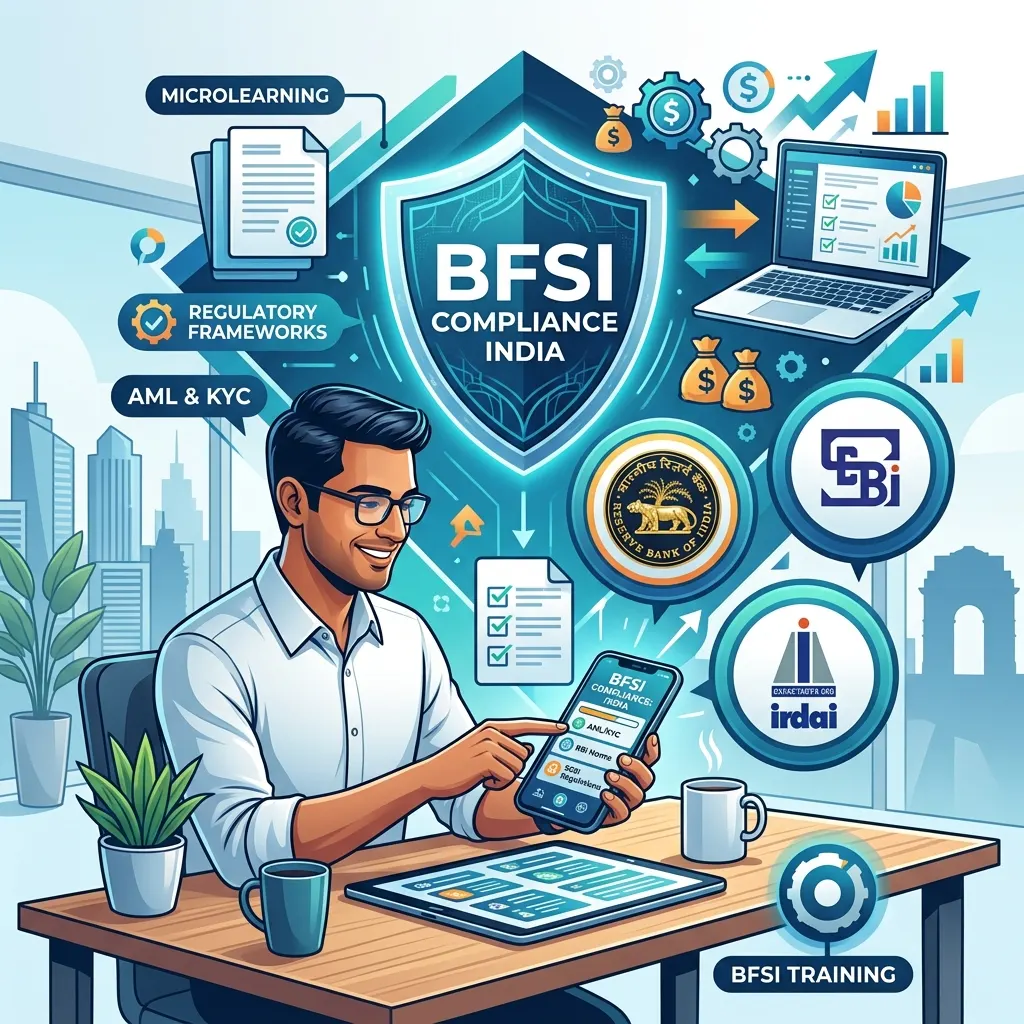
RBI, SEBI, and IRDAI requirements for branch staff, DSA agents, and recovery agents. Microlearning keeps 15,000 distributed agents current without branch-level classroom coordination.
Related reading: RBI 2026 Recovery Agent Training Rules: Compliance Guide
Manufacturing
Safety compliance (ISO 45001, OSHA, Factory Act). Daily toolbox talks and safety refreshers in vernacular languages.
Healthcare & Pharma
HIPAA, GMP, and GDP requirements. Workflow-embedded microlearning reaches healthcare workers during natural breaks.
Retail & FMCG
Food safety (FSSAI), consumer protection, and product handling compliance. Push compliance updates to every store simultaneously when regulations change.
The Bottom Line
Thirty-five percent of risk executives say compliance and regulatory risk is their company's biggest threat to growth. Compliance microlearning isn't a shortcut - it's a more rigorous model that delivers, reinforces, and verifies compliance knowledge continuously, in languages workers comprehend.
Make your frontline audit-ready - without a single classroom session. Leap10x delivers compliance microlearning on WhatsApp in 70+ languages with spaced reinforcement and conversational verification.