The Forgetting Curve Fix: How Spaced Microlearning Saves Frontline Retraining Budgets
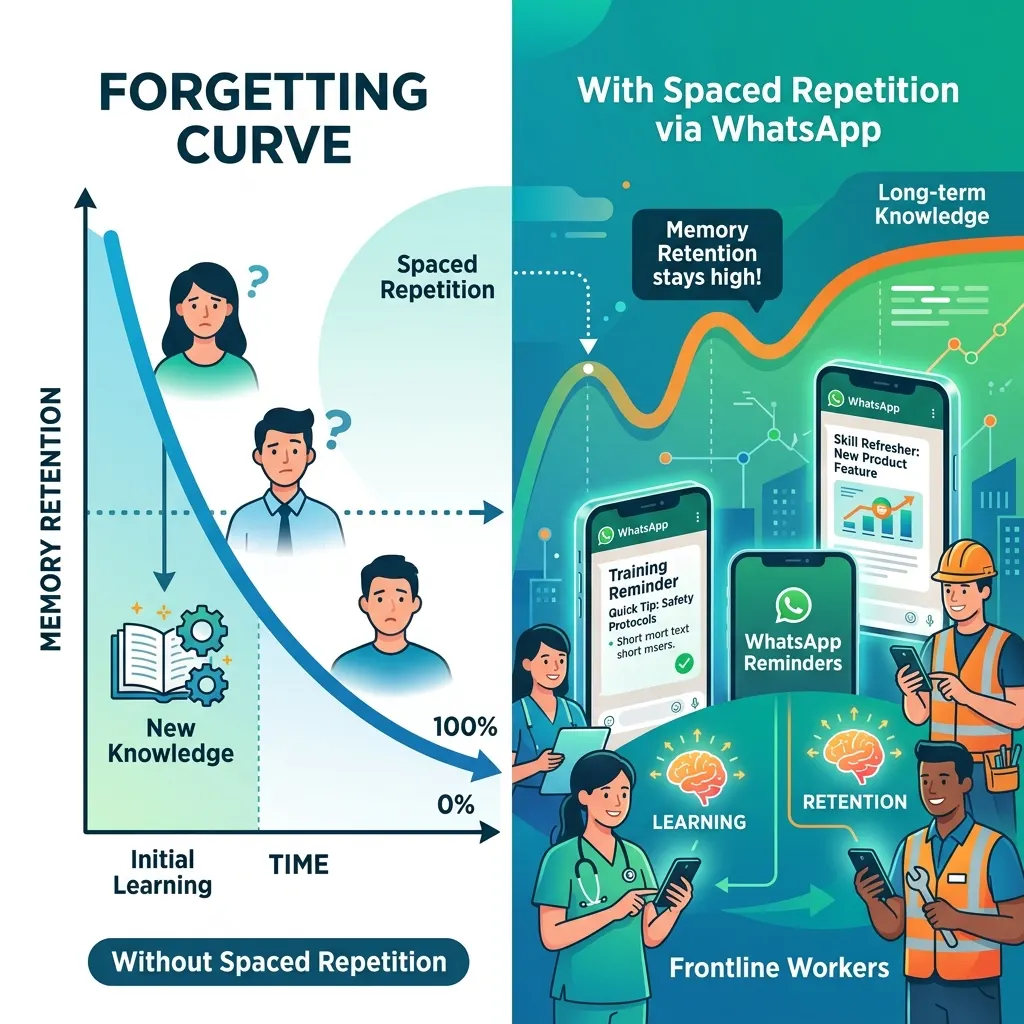
In 1885, German psychologist Hermann Ebbinghaus conducted a series of experiments on memory that L&D professionals are still grappling with 141 years later. His finding - now known as the forgetting curve - is brutally simple: without reinforcement, people forget approximately 50% of new information within one hour, 70% within 24 hours, and up to 90% within a week.
Think about what that means for your frontline training programme. That two-hour safety induction you ran last Monday? By Friday, your workers have retained roughly 10% of it. That product knowledge session before the festival season launch? The associate has forgotten most of the features before the first customer walks in.
The forgetting curve isn't a criticism of your workers' intelligence or your trainers' skills. It's a fundamental property of how human memory works. And it has a fix - one that doesn't require more training time, bigger budgets, or better attention spans. It requires a different delivery pattern.
That pattern is spaced microlearning.
Understanding the Forgetting Curve
The forgetting curve describes an exponential decline in memory retention over time:
- 20 minutes after training: ~42% of information forgotten
- 1 hour after training: ~56% forgotten
- 24 hours after training: ~70% forgotten
- 1 week after training: ~90% forgotten
- 1 month after training: virtually all detail-level information gone
The curve is steepest in the first hours and days, then gradually flattens. This means the window for reinforcement is narrow - and the standard practice of annual or quarterly refresher training misses it entirely.
Why Frontline Workers Are Hit Hardest
Information Overload
Research shows that 65% of employees feel overwhelmed by the volume of information in traditional training courses. When the brain is overloaded, retention drops even faster than Ebbinghaus predicted.
No Reinforcement Structure
Frontline workers complete a training and immediately return to a physically demanding job with no organic exposure to the material until it's needed in a real situation.
Stress and Cognitive Load
Factory floors are noisy. Delivery routes are stressful. Retail stores during peak hours are chaotic. High-stress environments impair memory encoding and retrieval.
Training Is Infrequent
A survey of 1,000 frontline employees found that 40% received training only once a year.
How Spaced Microlearning Defeats the Forgetting Curve
Spaced microlearning combines two evidence-based strategies:
Microlearning: Delivering information in small, focused chunks (3-5 minutes each).
Spaced repetition: Revisiting material at strategically timed intervals, just as the brain is about to forget it.
Here's what the pattern looks like in practice:
- Day 1: Worker completes a micro-module on a new safety procedure (3 minutes)
- Day 3: Worker receives a 2-question recall quiz on the same procedure
- Day 7: Worker gets a scenario-based question applying the procedure
- Day 14: Worker receives a brief refresher video with one key point reinforced
- Day 30: Worker takes a final assessment or participates in a conversational AI check
Each interaction takes under 3 minutes. Total investment: approximately 15 minutes spread over a month.
The Economics of Fighting the Forgetting Curve
Retraining Cost Elimination
If workers forget 90% of a training within a week, you're effectively paying for the same training multiple times. Spaced microlearning builds durable knowledge the first time.
Compliance Failure Prevention
Forgotten compliance training can result in violations with costs averaging $62,000 per incident. Regular micro-reinforcements keep compliance knowledge active.
Safety Incident Reduction
When safety procedures are reinforced through spaced repetition, they become reflexive rather than theoretical.
Productivity Maintenance
Workers who retain product knowledge and process steps perform at a higher baseline between formal training events.
Related reading: Microlearning ROI: Proving the Business Impact of Bite-Sized Frontline Training
Implementing Spaced Microlearning for Your Frontline
Step 1 - Identify Critical Knowledge
Focus on knowledge with the highest consequences of forgetting: safety procedures, compliance requirements, product information, and process steps where errors are expensive.
Step 2 - Design the Spacing Schedule
Initial module: Day 0. First recall check: Day 2-3. Application scenario: Day 7. Reinforcement refresher: Day 14. Assessment: Day 30.
Step 3 - Automate Delivery
With Leap10x, you create a learning drip journey - a sequence of micro-modules automatically pushed to workers at configured intervals.
Step 4 - Use Varied Formats
Each touchpoint should present the information differently: short video, multiple-choice quiz, scenario-based question, visual flashcard, conversational voice assessment.
Related reading: How to Train Frontline Workers Without Disrupting Operations
Step 5 - Close the Loop with Verification
The final step should involve genuine comprehension verification - a conversational assessment where workers articulate knowledge in their own words.
Related reading: Voice-Based Skills Assessment: The Missing Piece in India's Blue-Collar Training Stack
The Bottom Line
The forgetting curve isn't optional. It applies to every worker, in every industry, after every training session.
Spaced microlearning works with the grain of human cognition. The total time investment is less than traditional training. The retention is dramatically better. The science has been settled for 141 years. The technology to apply it at scale is now available and affordable.
Build training that actually sticks. Leap10x's WhatsApp microlearning includes automated drip journeys with spaced repetition. AI handles the scheduling. You measure the results.