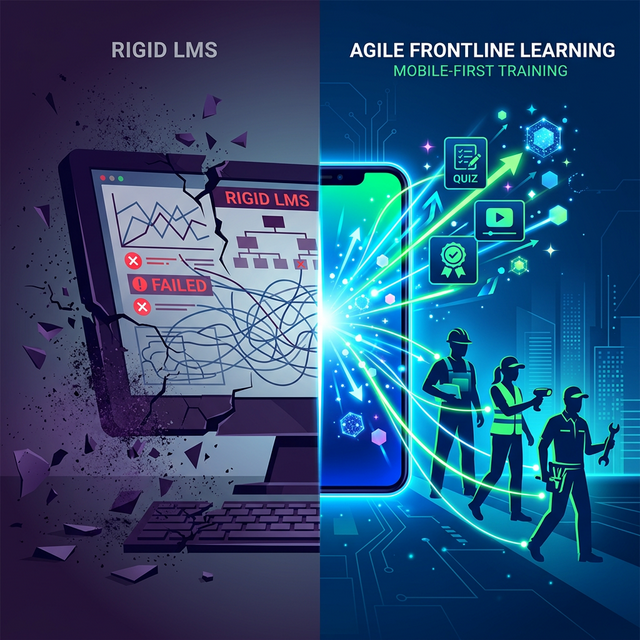
The L&D Leader's Guide to Training 80% of the Workforce You've Been Ignoring

Let's start with a number that should make every L&D leader uncomfortable: 80% of the global workforce - approximately 2.7 billion people - doesn't sit at a desk. Now pair it with another number: only 1% of software venture funding goes toward building technology for deskless workers.
These two numbers explain why most corporate L&D programmes are architecturally designed for a minority of the workforce. A survey of 1,000 frontline employees found that 40% received training only once a year.
This guide is for the L&D leader who's decided that the 80% deserves better.
The Strategic Case for Frontline Training Investment
The Direct Cost of Under-Training: Companies lose an average of $13.5 million per 1,000 employees annually due to insufficient training. McKinsey research shows losing a single frontline retail employee costs nearly $10,000.
The Revenue Opportunity: Trained frontline workers sell more, serve better, and retain customers longer.
The Compliance Imperative: RBI mandates for BFSI. FSSAI for food services. ISO 45001 for manufacturing safety. Regulations increasingly require evidence of comprehension, not just completion.
Related reading: Compliance Microlearning: How to Keep 10,000 Frontline Workers Audit-Ready
The Five Pillars of a Frontline Training Strategy
Pillar 1 - Channel-First Design
For 2.7 billion deskless workers - especially in India, Southeast Asia, and the GCC - the answer is WhatsApp. Completion rates: 85%+ (WhatsApp push) vs. 20-30% (portal pull).
Related reading: What Is a Frontline Training OS - and Why Is It Replacing Your LMS?
Pillar 2 - Content Velocity
AI content generation - converting existing PDFs and SOPs into micro-courses in under 10 minutes - is the baseline capability you need.
Related reading: AI-Powered Content Creation for L&D: How to Turn PDFs and SOPs into Training in Minutes
Pillar 3 - Language Equity
Auto-translation into workers' mother tongues is a non-negotiable requirement, not a nice-to-have.
Related reading: How to Train a Multilingual Frontline Workforce
Pillar 4 - Universal Coverage
Your training system must reach every worker - permanent, contract, temporary, and off-roll. Phone-number-based access ensures universal coverage.
Related reading: The Invisible Workforce: How to Train Contract Workers Who Aren't in Your HRMS
Pillar 5 - Verification, Not Just Delivery
Conversational assessment - where an AI agent calls workers and evaluates their verbal comprehension - proves understanding.
Related reading: Beyond Completion Rates: How to Measure If Frontline Training Is Actually Working
The Implementation Roadmap
Phase 1 - Pilot (4-6 Weeks)
One use case, one location, 100-200 workers. Measure completion rates, quiz scores, worker feedback. Success criteria: 70%+ completion.
Phase 2 - Expand Use Cases (2-3 Months)
Add compliance training. Begin spaced reinforcement. Add AI knowledge assistant. Include contract workers.
Phase 3 - Scale Organisation-Wide (3-6 Months)
Full workforce coverage. Conversational AI assessment for compliance-critical topics. Communication hub for policy updates. Measurement dashboard.
Phase 4 - Continuous Optimisation (Ongoing)
Analyse which training produces the strongest operational improvements. Report training ROI to business leadership quarterly.
Common Objections (And How to Address Them)
"Our frontline workers aren't tech-savvy enough." If they use WhatsApp to message their families, they have all the digital literacy needed.
"We need classroom training for hands-on skills." Microlearning doesn't replace hands-on training. It supplements it by delivering the knowledge component digitally.
"We've already invested in our LMS." Keep it for desk-based workers. Add a frontline training layer for deskless workers.
"Contract workers are the staffing agency's responsibility." Legally, you retain compliance responsibility for workers on your premises.
The Bottom Line
The 80% has been an afterthought in corporate training for decades. Not because L&D leaders don't care - but because the available technology was built for the other 20%.
That's no longer the case. WhatsApp-native training platforms, AI content generation, multilingual auto-translation, and conversational AI assessment have removed every technical barrier.
The LMS frontline worker training market reached $16.88 billion in 2025 and is projected to grow at 12.5% CAGR through 2033. The organisations that invest now will set the standard for their industries.
Ready to train the 80% you've been missing? Leap10x is the frontline training OS built for workers who don't sit at desks. Start with a free pilot and see the difference in your first week.