Safety Training for Oil, Gas and Energy Field Crews
Quick answer
Oil and gas extraction has a fatality rate about seven times the US average. A mobile-first approach to safety and compliance training for remote, contractor-heavy field crews.
Oil and gas field work combines almost every serious workplace hazard in one place: heavy equipment, high-pressure systems, flammable and toxic gases, work at height, confined spaces, long drives to remote sites and long shifts. Crews rotate, contractors come and go, and sites are often far from any classroom or reliable network.
The numbers reflect that. NIOSH research found that oil and gas extraction workers had a fatality rate of 27.1 per 100,000 workers over 2003–2010, roughly seven times the rate for all US workers, with transportation incidents the leading cause of death, as reported by Occupational Health & Safety and in CDC/NIOSH publications. Rates have changed since, but the hazard profile hasn't.
This guide is for HSE managers, operations leaders and L&D teams in oil, gas and broader energy operations (including renewables and utilities) who want safety and compliance training that actually reaches field crews.
Why traditional safety training struggles in the field
- Remote, rotating crews. Workers on rotation are rarely all in one place, and classroom sessions mean pulling people off sites or travelling long distances.
- Heavy use of contractors. Much field work is done by contractors and subcontractors, who may not be in the operator's systems.
- Patchy connectivity. Remote pads, rigs and substations often have limited bandwidth.
- Long, generic modules. Annual online courses designed for desks don't fit a 12-hour shift or a crew truck.
- Language. In the US, many field crews include Spanish-speaking workers; in other regions, crews speak many languages.
- Knowledge decay. A safety course taken months ago doesn't help when an unusual job comes up today.
What field crews need, beyond the mandatory courses
Mandatory and certification training (whatever your regulators, clients and industry bodies require) stays in place. This guide is about the layer around it: the short, frequent, job-specific training that keeps knowledge fresh and connects procedures to real work. Check your specific regulatory and client requirements with your HSE and legal teams.
Core hazard refreshers
Short, recurring lessons on the hazards that kill and injure people in your operations, for example:
- Driving and journey management.
- Struck-by and caught-in hazards around equipment.
- Fire and explosion risks, hot work and gas testing.
- Toxic gas awareness, such as hydrogen sulphide (H2S), where relevant.
- Working at height and fall protection.
- Confined space entry.
- High-pressure lines and stored energy, including lockout/tagout. See our LOTO training guide.
- Fatigue and long shifts.
Pre-job and task-specific refreshers
A three-minute lesson on the specific job about to happen, for example a well intervention, a crane lift or a confined space entry, sent to the crew the day before or that morning.
Lessons learned from incidents
When an incident or serious near-miss happens anywhere in the operation, turn the learnings into a short lesson and get it to every relevant crew within days. This is one of the highest-value uses of microlearning in high-hazard industries.
Stop work authority
Every worker should know they can stop a job they believe is unsafe, and how. Reinforce it regularly with real scenarios.
Contractor onboarding
A consistent site-specific induction for every contractor before first entry. See contractor safety induction training.
A mobile-first training model for field crews
1. Pre-mobilisation
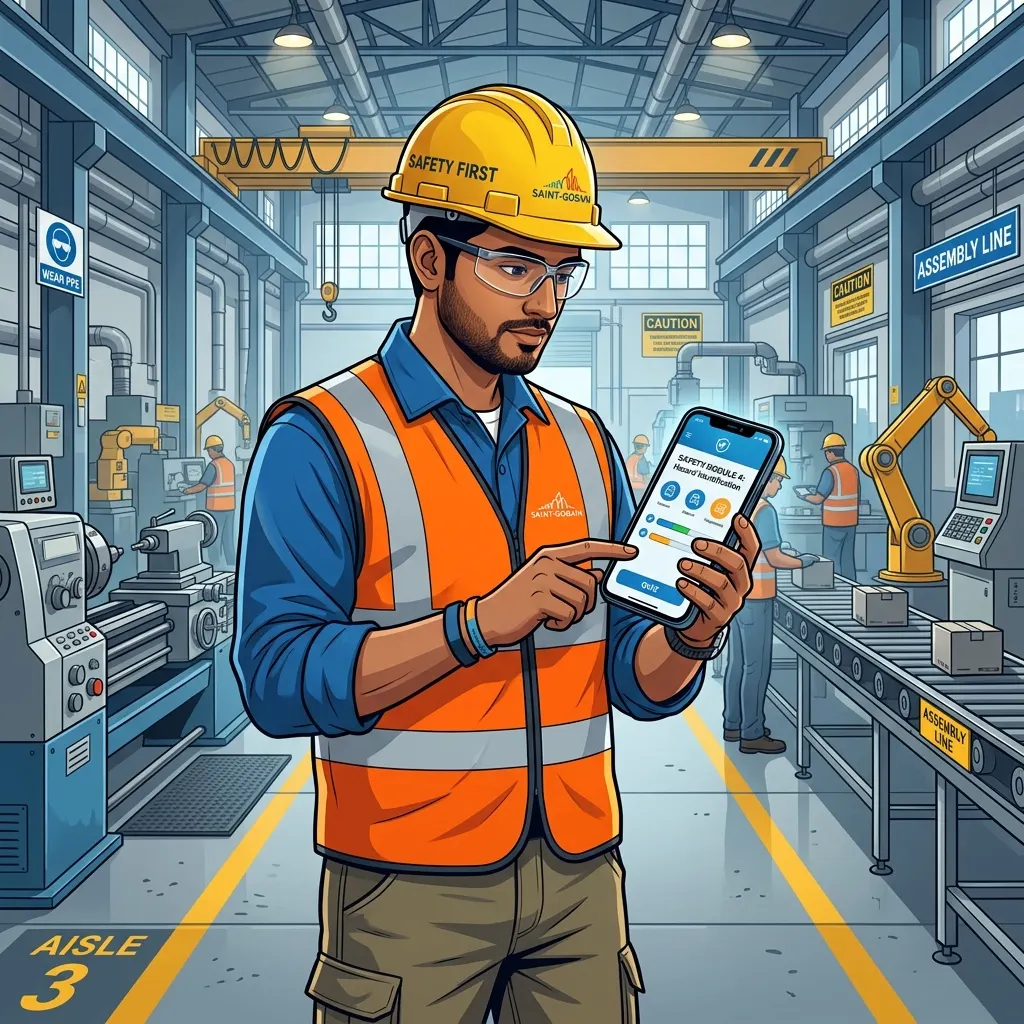
Before a worker arrives on site or starts a rotation, send the site-specific induction and the key hazard refreshers to their phone. They complete it at home or in camp, not on the clock at the site gate.
2. Digital toolbox talks
Pair the morning toolbox talk with a two-minute lesson and a question or two, so you have a record of what was covered and who understood it. Our digital toolbox talk guide has topic ideas.
3. Short, frequent reinforcement
One short lesson or scenario a few times a week beats an annual course. Spread the core hazards across the year.
4. Answers in the field
When a worker is unsure about a procedure, they should be able to look it up in seconds, or ask a question and get the answer from approved procedures. Uncertainty plus pressure to keep the job moving is a dangerous combination.
5. Low-bandwidth design
Keep lessons light: text, images and short audio rather than long videos, so they load on weak signals. See our low-bandwidth mobile training guide.
6. Language and literacy
Deliver lessons in the languages your crews use, with audio. Where literacy varies, lean on photos, diagrams and voice.
7. Records for audits and clients
Operators and contractors are often asked to prove training to clients, auditors and contractor prequalification programs. Keep per-worker records of completion, scores and dates, exportable on demand.
Building a safety culture, not just a training record
Training only works inside a culture where people report hazards and near-misses without fear, and where supervisors model safe behaviour. See our guides to near-miss reporting and speak-up culture and behaviour-based safety.
Choosing the right channel
The right delivery channel depends on your workforce and your policies on personal devices:
- WhatsApp is often the best channel for crews in India, the Middle East, Africa and Latin America.
- Shared site devices or kiosks suit locations where personal phones aren't allowed in operational areas. Never encourage phone use in hazardous zones; training should happen before shifts, in camp, or in designated safe areas.
What to measure
- Pre-mobilisation completion before site arrival.
- Completion and scores on core hazard refreshers.
- Time from incident to lessons-learned lesson reaching all crews.
- Near-miss reporting rates.
- Recordable incidents and severity.
- Audit and client findings related to training.
Renewable energy and utilities
The same approach applies to solar, wind and utility crews: remote sites, electrical and height hazards, contractors and rotating teams. For solar specifically, see solar and renewable energy technician training in India.
How Leap10x helps
Leap10x is a mobile-first microlearning platform for frontline and deskless workers:
- AI builds lessons from your HSE procedures, JSAs and incident reports in about 10 to 15 minutes, in 70+ languages with audio.
- Delivery on WhatsApp, email, teams slack and with SMS and authenticated QR codes on Enterprise plans, so crews can complete lessons on their phones without an app or login.
- Reaches contractors with just a phone number.
- Records: per-worker completion, scores and timestamps, with PDF certificates and CSV exports.
- Assist answers procedural questions from your approved documents only.
- Security: ISO 27001:2022 certified, with US, EU or India data residency on Enterprise plans.
Leap10x doesn't replace certified training, practical competence assessments or your safety management system. It keeps knowledge fresh between them. Customers see completion rates of 85% and above, compared with 20–30% for typical LMS rollouts. For the wider compliance curriculum, see our compliance microlearning module library.
FAQ
Why is oil and gas safety training so important?
Oil and gas extraction has historically had a fatality rate around seven times the US average, with transportation incidents, equipment, fires and explosions among the main hazards. Effective, frequent training is a core control.
How do you train remote field crews?
Use short mobile lessons delivered before mobilisation and during rotations, digital toolbox talks, low-bandwidth content, field access to procedures, and per-worker records.
Can microlearning replace mandatory safety certifications?
No. Microlearning supports mandatory and certified training by reinforcing knowledge, sharing lessons learned and preparing crews for specific tasks.
How should contractors be trained on site safety?
Give every contractor a consistent, site-specific induction before first entry, delivered to their phone, with a record of completion and understanding.
CTA: Want lessons learned from your last incident in every crew's hands this week? Book a demo or start free for 14 days.
Frontline training
Training software built for deskless teams
Onboarding, SOPs, safety refreshers, and compliance evidence for workers with no corporate email and no company device — tracked by site, role, and shift.