WhatsApp Training vs. App-Based LMS: Which Works Better for Deskless Workers?
Quick answer
Here's a scenario that plays out thousands of times every day across Indian factories, retail stores, warehouses, and field operations: an L&D team builds a…
The Training Access Problem Nobody Wants to Admit
Here's a scenario that plays out thousands of times every day across Indian factories, retail stores, warehouses, and field operations: an L&D team builds a training program, uploads it to their Learning Management System, sends login credentials to employees - and then watches completion rates stall at 30-40%.
It's not because the content is bad. It's because the delivery channel doesn't match the worker.
Deskless workers - the 2.7 billion people globally who work in restaurants, factories, retail stores, logistics hubs, and field operations - face fundamentally different technology constraints than office employees. They don't have company laptops. Many don't have company email addresses. Their internet connectivity is inconsistent. And their available time for training is measured in minutes between tasks, not hours blocked on a calendar.
Yet the training technology market remains dominated by app-based LMS platforms designed for desk workers. These platforms assume email-based login, stable WiFi, and 30-60 minute learning sessions - assumptions that collapse the moment you step onto a factory floor or into a retail stockroom.
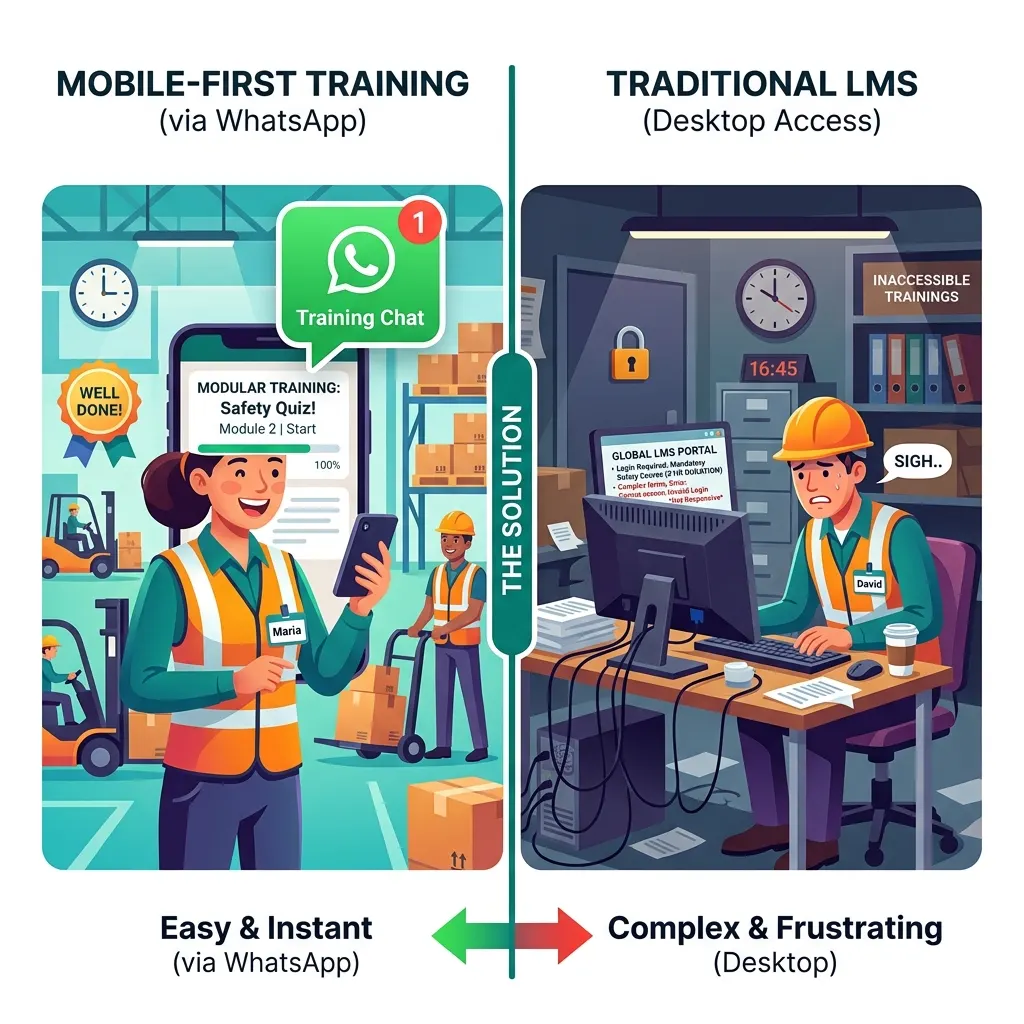
WhatsApp-based training takes a radically different approach: deliver learning through a channel workers already use dozens of times daily, requiring zero additional downloads, zero new credentials, and zero behaviour change.
This comparison examines both approaches - their strengths, their limitations, and which one actually works for deskless teams - using real-world data and practical criteria that matter when you're training workers who don't sit at desks.
For a deep dive into the WhatsApp training approach specifically, see our WhatsApp-Based Training for Employees: Complete 2026 Guide.
Head-to-Head Comparison: The 7 Criteria That Matter
1. Adoption and Access
App-Based LMS: Requires workers to download an app, create an account, and remember login credentials. For workers without company email, this often requires IT support for QR code or phone-number login. Even the best frontline LMS platforms - like Opus Training with QR code login or 7taps with no-app-required delivery - still face the initial friction of a new tool in the worker's routine.
WhatsApp Training: Zero friction. Over 500 million Indians already use WhatsApp daily. Workers receive training as a message in a channel they check constantly. No download, no login, no new behaviour required. Adoption rates are immediate because there's nothing to adopt.
Verdict: WhatsApp wins on adoption. The best predictor of training completion is whether workers actually access the content. WhatsApp removes every barrier to access.
2. Content Richness and Interactivity
App-Based LMS: Supports rich content formats - SCORM packages, branching scenarios, video courses, gamified quizzes, simulations, and complex learning paths. Platforms like Docebo offer AI-powered personalization that adapts content to individual learner performance. For complex skill development, the content capabilities of a dedicated LMS are superior.
WhatsApp Training: Supports text, images, short videos, audio, documents, and interactive reply-based quizzes. Modern WhatsApp Business API integrations enable structured learning journeys with branching paths. However, it can't match the rich interactivity of a dedicated LMS. No SCORM support, no gamification leaderboards, no complex simulations.
Verdict: App-based LMS wins on content richness. If your training requires complex scenarios, branching simulations, or gamified experiences, a dedicated platform delivers more.
3. Engagement and Completion Rates
App-Based LMS: Industry averages for frontline LMS completion range from 50-70%, depending on the platform and content quality. The main engagement killers are login friction, forgettable content, and competition with other apps for the worker's attention.
WhatsApp Training: Completion rates consistently hit 85-95%. The reasons are structural: training arrives in the same message feed as personal and work conversations. Workers don't need to make a separate decision to "go learn" - the content meets them where they already are. Push notifications on WhatsApp have near-100% visibility versus 10-20% open rates for LMS notifications.
Verdict: WhatsApp wins on engagement and completion. The data is consistent - channel familiarity drives dramatically higher completion rates.
4. Multilingual Support
App-Based LMS: Most enterprise LMS platforms offer interface translation into major languages. Content translation varies - some platforms offer AI auto-translation (Opus Training supports 130+ languages), others require manual translation for each course. Workers must navigate an interface that may not be in their language before they can access content that is.
WhatsApp Training: Content arrives pre-translated in the worker's preferred language within a familiar interface they already use in that language. There's no "interface" layer to navigate - the training IS the message. WhatsApp-native platforms can auto-translate content across Indian regional languages, delivering personalized language experiences without additional friction.
Verdict: WhatsApp has the edge for multilingual frontline teams. The training content and the delivery interface exist in the same language the worker already uses daily.
5. Analytics and Compliance Tracking
App-Based LMS: Purpose-built for tracking. Detailed analytics on completion, assessment scores, time-spent, learning paths, certification status, and compliance records. Integrates with HRIS systems for automated reporting. Audit-ready compliance tracking is a core capability.
WhatsApp Training: Analytics depend on the platform integrating with WhatsApp Business API. Modern platforms track message delivery, content opens, quiz completions, and assessment scores. However, the depth of analytics typically doesn't match a dedicated LMS - especially for complex compliance requirements with certification management and audit trails.
Verdict: App-based LMS wins on analytics depth. If your training program has heavy compliance documentation requirements, a dedicated LMS provides stronger audit infrastructure.
6. Cost of Deployment and Maintenance
App-Based LMS: Pricing typically ranges from $3-8 per user per month, with enterprise platforms requiring custom quotes. Add implementation costs (often $10,000-50,000+ for enterprise LMS), content creation costs, and ongoing administration. Many platforms require dedicated LMS administrators.
WhatsApp Training: Generally lower cost per user because the delivery infrastructure (WhatsApp) is already installed and maintained. No app development, no app store management, no device compatibility testing. Platforms that integrate with WhatsApp Business API typically charge per active user or per message, with total costs 40-60% lower than comparable LMS deployments.
Verdict: WhatsApp training is typically more cost-effective, especially for large deskless workforces where LMS license costs scale linearly with headcount.
7. Scalability Across Locations
App-Based LMS: Scales well for centrally managed training programs across locations. Multi-location dashboards, role-based content assignment, and regional content management are standard features. However, scaling requires each worker at each location to complete the adoption process (download, login, learn the interface).
WhatsApp Training: Scales instantly. Adding a new location to your training program means adding phone numbers to a distribution list. New workers receive their first training module the same day they're added - no onboarding to a separate platform required. For businesses opening new locations or scaling rapidly, this speed-to-training advantage is significant.
Verdict: WhatsApp wins on speed of scale. App-based LMS wins on management sophistication at scale.
When to Choose What: A Decision Framework
Choose WhatsApp-based training when:
- Your workforce doesn't have company email addresses or laptops
- Workers are distributed across many locations with inconsistent connectivity
- Your team is multilingual and needs content in regional languages
- Training is primarily microlearning - compliance refreshers, SOP updates, product knowledge
- You need rapid deployment with minimal IT involvement
- High completion rates matter more than deep analytics
- Your workforce has high turnover and onboarding speed is critical
Choose an app-based LMS when:
- Training requires complex content formats (SCORM, simulations, branching scenarios)
- You have heavy compliance documentation requirements with certification management
- Your L&D team needs deep analytics for strategic workforce development
- Workers have company-issued devices with reliable connectivity
- You need integration with enterprise HR and performance management systems
- Training programs are long-form (multi-hour courses, certification paths)
Choose a hybrid approach when:
- You need WhatsApp for frontline delivery (reach and engagement) but an LMS for compliance documentation (audit trails)
- Different worker populations have different needs - field agents on WhatsApp, office managers on LMS
- You want to use WhatsApp for microlearning and reinforcement while using LMS for initial deep training
For a related comparison of microlearning platforms, see our 7taps vs Leap10x: Honest Microlearning Comparison (2026).
The Bigger Picture: Meeting Workers Where They Are
The training technology debate often centres on features, integrations, and content capabilities. But the most important question is simpler: will your workers actually use it?
A sophisticated LMS with rich content and deep analytics that achieves 40% completion delivers less value than a WhatsApp-based program with basic quizzes that achieves 90% completion. Training that doesn't reach workers doesn't train them - regardless of how impressive the platform looks in a demo.
For India's deskless workforce - the 450 million workers who keep the economy moving - WhatsApp isn't just a messaging app. It's the digital infrastructure they actually use. Building training on that foundation isn't a compromise. It's a strategic advantage.
Ready to see what WhatsApp-native training can do for your frontline? Book a demo with Leap10x and see how training delivered through WhatsApp achieves completion rates that app-based platforms can't match.
WhatsApp LMS
Everything an LMS does — inside WhatsApp
Course libraries, enrolment, assessments, certificates, and audit-ready completion logs, with WhatsApp as the learner interface instead of a portal nobody opens.