Frontline Enablement Strategy: A 5-Part Framework
Quick answer
Frontline enablement is more than training. A five-part framework (reach, readiness, resources, voice, results) with a maturity model and a 90-day plan.
"Frontline enablement" has become a popular phrase, borrowed from sales enablement. The idea is simple: give frontline workers what they need to do their jobs well (knowledge, skills, information, tools and support) at the moment they need it.
The trouble is that most organisations treat enablement as a synonym for training, or as a platform purchase. Neither works on its own. A great training platform that workers don't open isn't enablement. A brilliant knowledge base nobody can search from the shop floor isn't enablement. Enablement is a strategy, and it has several parts.
This article sets out a five-part framework for frontline enablement, a simple maturity model to see where you stand, and a 90-day plan to move forward. If you want the definition and platform landscape first, start with our explainer on what a frontline enablement platform is.
Why enablement matters now
Around 80% of the world's workforce is deskless, according to Emergence Capital, yet most workplace technology was built for desk workers. Meanwhile, frontline roles are getting more complex: more products, more procedures, more regulation, more technology on the floor, and more turnover. The gap between what frontline workers need to know and what reaches them keeps widening.
Enablement is how you close it.
The five-part framework
We use five Rs: Reach, Readiness, Resources, Recognition and voice, and Results.
1. Reach: can you get to every worker?
Everything else depends on this. If information and training can't reach a worker quickly, on a device they have, in a language they understand, nothing else in the enablement strategy works.
Questions to ask:
- What share of frontline workers can you reach directly within 24 hours?
- Does it include part-timers, night shifts, contractors and agency staff?
- Does it require apps, logins or company email?
What good looks like: A direct channel to every worker, based on what they already have (for many workforces, a phone number and a messaging app), with confirmation that messages were seen.
2. Readiness: do workers have the skills and knowledge?
This is the training layer: onboarding, SOPs, safety, product knowledge, compliance and skills development.
Questions to ask:
- How long does it take a new hire to become proficient?
- How quickly can you train everyone on a new procedure or product?
- How do you know workers understood, not just attended?
What good looks like: Short, multilingual lessons delivered when needed, with knowledge checks, reinforcement over time and practical sign-offs for critical skills. See our guide to time to proficiency.
3. Resources: can workers find answers in the moment?
Training builds a foundation, but nobody remembers everything. Workers need fast access to answers when they're unsure.
Questions to ask:
- When a worker is unsure mid-task, what do they actually do?
- How long does it take to find the right procedure?
- Are answers in their language?
What good looks like: A searchable library of short procedures and a knowledge assistant that answers questions from approved documents, with citations and human handoff. See how a RAG knowledge assistant on WhatsApp works.
4. Recognition and voice: do workers feel seen and heard?
Enablement isn't only top-down. Workers who feel recognised and listened to are more engaged, stay longer and surface problems early.
Questions to ask:
- How often do you ask frontline workers for their views, and act on them?
- Can workers easily report problems, near-misses or ideas?
- How is good work recognised?
What good looks like: Regular short pulse checks, easy reporting, visible action on feedback, and recognition that reaches the frontline. See WhatsApp pulse surveys for frontline teams and employee recognition on WhatsApp.
5. Results: is enablement improving performance?
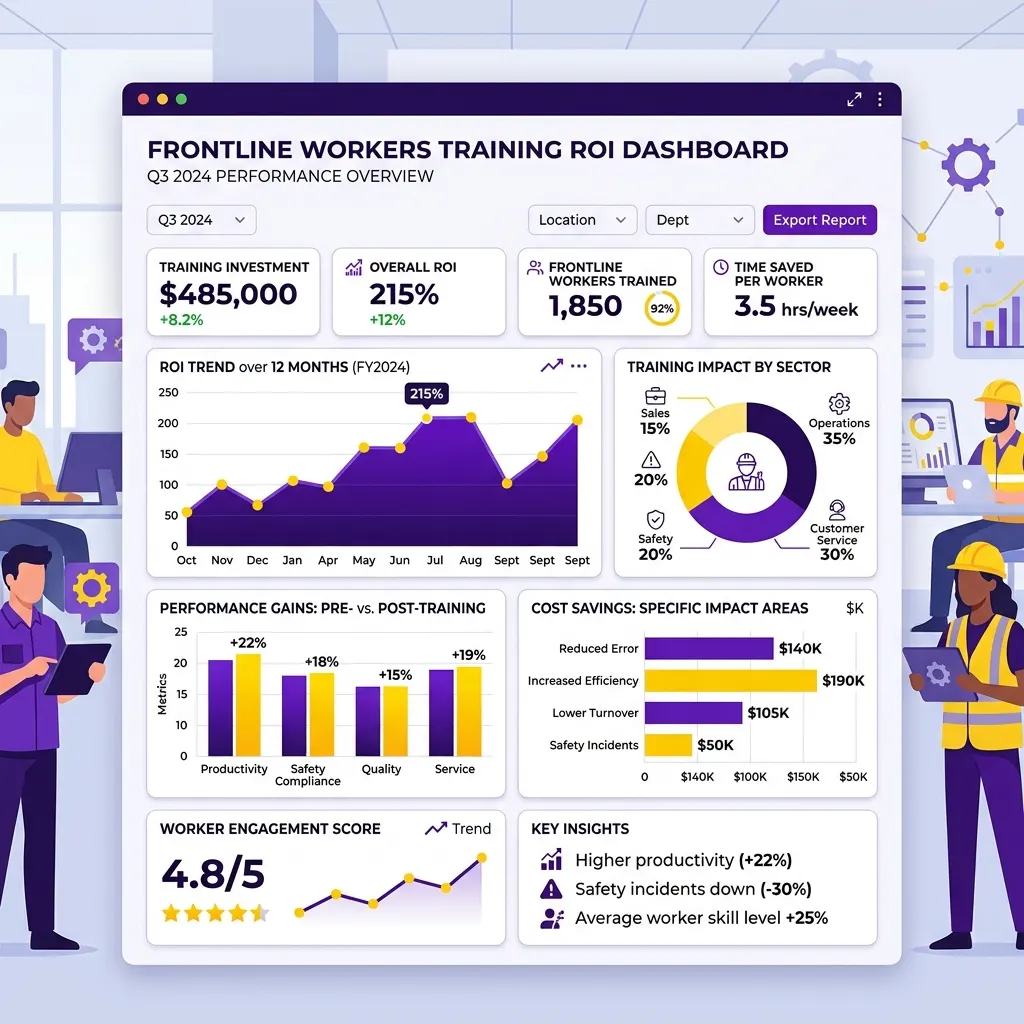
Enablement has to show up in operational outcomes, or it becomes another activity metric.
Questions to ask:
- Which operational metrics should enablement move: errors, safety incidents, ramp-up time, customer satisfaction, retention, sales of new products?
- Can you see enablement data next to operational data?
What good looks like: Each enablement initiative tied to a metric an operations leader already owns, reviewed in regular operations meetings. See our frontline training ROI measurement framework.
A simple maturity model
Score yourself from 1 to 4 on each R.
Level 1: Ad hoc. Information travels through managers and noticeboards. Training is classroom-based at induction. No reliable way to reach every worker. Little data.
Level 2: Digitised. An LMS or app exists, but frontline usage is low. Some content is digital. Data is patchy and mostly about completion.
Level 3: Connected. A direct channel reaches most workers. Training is short and multilingual. Managers have visibility. Some feedback loops exist. Training data is reviewed regularly.
Level 4: Integrated. Every worker is reachable. Training, resources and feedback flow through channels workers already use. Enablement data sits alongside operational data, and operations leaders own the outcomes.
Most organisations we speak to are at Level 1 or 2 on Reach, which caps everything else.
Who should own frontline enablement?
Enablement fails when it belongs to everyone and no one. A practical split:
- Operations owns the outcomes and targets, because results show up in operational metrics. We argued this in frontline training belongs to operations.
- L&D owns readiness: content standards, training design and measurement.
- HR and internal comms own recognition, voice and policy communication.
- IT owns security, integration and data governance.
- A single enablement lead coordinates, so the frontline isn't hit by five uncoordinated channels.
A 90-day plan
Days 1 to 30: Diagnose and pick a channel
- Score yourself on the five Rs.
- Trace your last three important updates: how many workers actually received and understood them?
- Choose one direct channel that reaches every worker without new apps or logins.
- Pick one operational metric and one site or region for a pilot.
Days 31 to 60: Build readiness and resources for the pilot
- Convert the five to ten most critical procedures into short, multilingual lessons.
- Set up a way for workers to ask questions and get answers from approved documents.
- Brief supervisors and give them visibility of their team's progress.
- Run a first two-question pulse check.
Days 61 to 90: Measure and decide
- Compare the pilot metric with the baseline.
- Review worker and supervisor feedback.
- Decide what to scale, what to fix and what to drop.
- Present results in the operations review, not just an L&D report.
Common mistakes
- Buying a platform and calling it a strategy. Tools support enablement; they don't define it.
- Skipping Reach. Investing in content and AI before solving how to reach workers.
- Too many channels. Every department sending its own messages, recreating noise.
- Measuring activity. Messages sent and modules completed instead of operational outcomes.
- Forgetting voice. Enablement that only pushes information and never listens.
Where Leap10x fits
Leap10x is a WhatsApp-first platform for frontline and deskless workers. Mapped to the framework:
- Reach: lessons and announcements on WhatsApp, with no app, login or company email (Leap10x Reach for comms).
- Readiness: AI-built, short, multilingual lessons with quizzes and reminders (Leap10x MicroLearning), in 70+ languages.
- Resources: Leap10x Assist, a knowledge assistant on WhatsApp that answers from approved SOPs.
- Results: real-time data by region, team and individual, with exports and HRMS integration on Enterprise plans.
Recognition programmes and operational task management sit outside Leap10x's core; many customers pair us with other tools for those. Customers see completion rates of 85% and above, compared with 20–30% for typical LMS rollouts. For the bigger picture, see Frontline 2.0.
FAQ
What is frontline enablement?
Giving frontline workers the knowledge, skills, information, tools and support they need to do their jobs well, at the moment they need it, and measuring the effect on performance.
How is frontline enablement different from training?
Training is one part (readiness). Enablement also covers reaching every worker, giving them answers on demand, listening to them, and linking all of it to operational results.
What does a frontline enablement platform do?
Typically it combines direct communication, short training, knowledge access and feedback for frontline workers, with data for managers. Platforms vary in which parts they cover well.
Where should a frontline enablement strategy start?
With reach: make sure you can get information and training to every worker directly, without new apps or logins. Everything else builds on that.
CTA: Want to score your organisation on the five Rs? Book a demo and we'll run the diagnostic with you, or start free for 14 days.
Frontline training
Training software built for deskless teams
Onboarding, SOPs, safety refreshers, and compliance evidence for workers with no corporate email and no company device — tracked by site, role, and shift.