How to Measure Frontline Training ROI: A Data-Driven Framework for Blue-Collar Workforces
Quick answer
Ask an L&D leader if their frontline training is working, and you'll hear about completion rates.
Ask an L&D leader if their frontline training is working, and you'll hear about completion rates. "We achieved 78% completion on the safety module." "Onboarding completion is up 15% this quarter."
Ask a CFO the same question, and they'll want to know something entirely different: "Did it reduce turnover? Did it prevent safety incidents? Did it make new hires productive faster? What's the return on our training investment?"
Completion rates are a training metric. ROI is a business metric. And the gap between the two is where most frontline training programmes lose executive support.
This guide provides a practical framework for measuring the actual business impact of frontline training - specifically designed for blue-collar workforces in manufacturing, retail, logistics, and hospitality where training outcomes are directly tied to operational performance.
Why Traditional Training Metrics Fall Short
The metrics most L&D teams report are inputs and outputs, not outcomes:
- Hours of training delivered (input)
- Number of workers trained (input)
- Completion rates (output)
- Average quiz scores (output)
- Satisfaction ratings (output)
These metrics tell you whether training happened. They don't tell you whether training worked.
A worker can complete a safety module and still cause an incident. A server can ace a customer service quiz and still deliver poor service. A factory operator can finish machine training and still produce defective parts.
The only metrics that matter for ROI are those that connect training activity to business outcomes. And for blue-collar workforces, those outcomes are concrete, measurable, and financially significant.
The Frontline Training ROI Framework
This framework connects training investment to four measurable business outcome categories, each with specific metrics, measurement methods, and calculation approaches.
Outcome 1: Turnover Reduction
Why it matters: Replacing a frontline worker costs approximately 40% of their annual salary (Gallup). For an organisation with 5,000 frontline workers at 60% turnover, that's potentially thousands of departures per year, each costing thousands in direct and indirect expenses.
The training connection: Employees who receive adequate training are significantly more likely to stay. One in three restaurant workers cite inadequate training as their reason for leaving. Companies with structured onboarding improve retention by up to 82%.
How to measure:
Step 1: Calculate your baseline annual turnover rate for frontline workers.
Step 2: Calculate your cost per departure (recruiting + hiring + onboarding + lost productivity during vacancy and ramp-up).
Step 3: After implementing WhatsApp training, measure the new turnover rate.
Step 4: Calculate savings: (baseline departures - new departures) × cost per departure.
Expected improvement: Organisations implementing structured WhatsApp-based training typically see 15-25% reductions in frontline turnover within the first year.
Example calculation:
- 5,000 frontline workers at 60% turnover = 3,000 departures/year
- Cost per departure = ₹3,50,000 ($4,200)
- A 15% reduction = 450 fewer departures
- Annual savings = 450 × ₹3,50,000 = ₹15.75 crore ($18.9M)
Outcome 2: Safety Improvement
Why it matters: Workplace injuries are extraordinarily expensive. Beyond the human cost, each recordable incident carries direct costs (medical, compensation) and indirect costs (investigation, production loss, insurance premiums, potential regulatory fines).
The training connection: The lack of appropriate employee training is identified as one of the primary underlying factors of workplace accidents. Continuous safety reinforcement through WhatsApp addresses the forgetting curve that makes annual classroom training ineffective.
How to measure:
Step 1: Document your baseline metrics - Total Recordable Incident Rate (TRIR), number of near-misses, first-aid cases, and lost-time injuries.
Step 2: Calculate the average cost per incident (include medical costs, compensation, investigation time, lost production, and insurance impact).
Step 3: After implementing WhatsApp safety training, measure the new incident rates.
Step 4: Calculate savings: (baseline incidents - new incidents) × average cost per incident.
Expected improvement: Organisations implementing continuous WhatsApp-based safety training report 30-40% reductions in recordable incidents.
Example calculation:
- Baseline: 50 recordable incidents per year
- Average cost per incident: ₹5,00,000 ($6,000)
- A 35% reduction = 17-18 fewer incidents
- Annual savings = 17 × ₹5,00,000 = ₹85 lakh ($1.02M)
Outcome 3: Productivity Acceleration
Why it matters: Every day a new hire operates below full productivity is a day of diminished output. For frontline roles where output is directly measurable - units produced, orders fulfilled, customers served - the cost of slow onboarding is quantifiable.
The training connection: WhatsApp-based onboarding gets workers floor-ready faster by delivering foundational knowledge before hands-on training begins and reinforcing it continuously throughout the ramp-up period.
How to measure:
Step 1: Define "full productivity" for each frontline role (e.g., orders processed per hour, units produced per shift).
Step 2: Measure the average time for new hires to reach full productivity under the current training approach.
Step 3: After implementing WhatsApp onboarding, measure the new time-to-productivity.
Step 4: Calculate savings: (days saved) × (daily productivity shortfall value) × (number of new hires per year).
Expected improvement: 20-30% reduction in time-to-full-productivity.
Outcome 4: Training Delivery Cost Reduction
Why it matters: Traditional classroom-based training carries substantial direct costs that many organisations accept as unavoidable but are in fact highly compressible.
How to measure:
Calculate your current annual spending on:
- Trainer salaries (portion dedicated to frontline training delivery)
- Venue costs (classroom rental, setup)
- Materials (printed manuals, handouts)
- Travel (trainer travel to multiple locations)
- Opportunity cost (production time lost when workers attend classroom sessions)
- LMS licensing (if applicable, for the frontline-facing portion)
After implementing WhatsApp training, calculate the new annual spending on:
- Platform licensing fee
- Content development/conversion time
- Admin and management time
- Any remaining in-person training costs
The difference is your training delivery cost savings.
Expected improvement: 40-60% reduction in per-worker training delivery costs.
Building the ROI Model
Combine all four outcome categories into a single ROI calculation:
Total Annual Savings = Turnover savings + Safety savings + Productivity savings + Delivery cost savings
Total Annual Investment = Platform licensing + Content conversion + Admin time + Change management
ROI = (Total savings - Total investment) / Total investment × 100
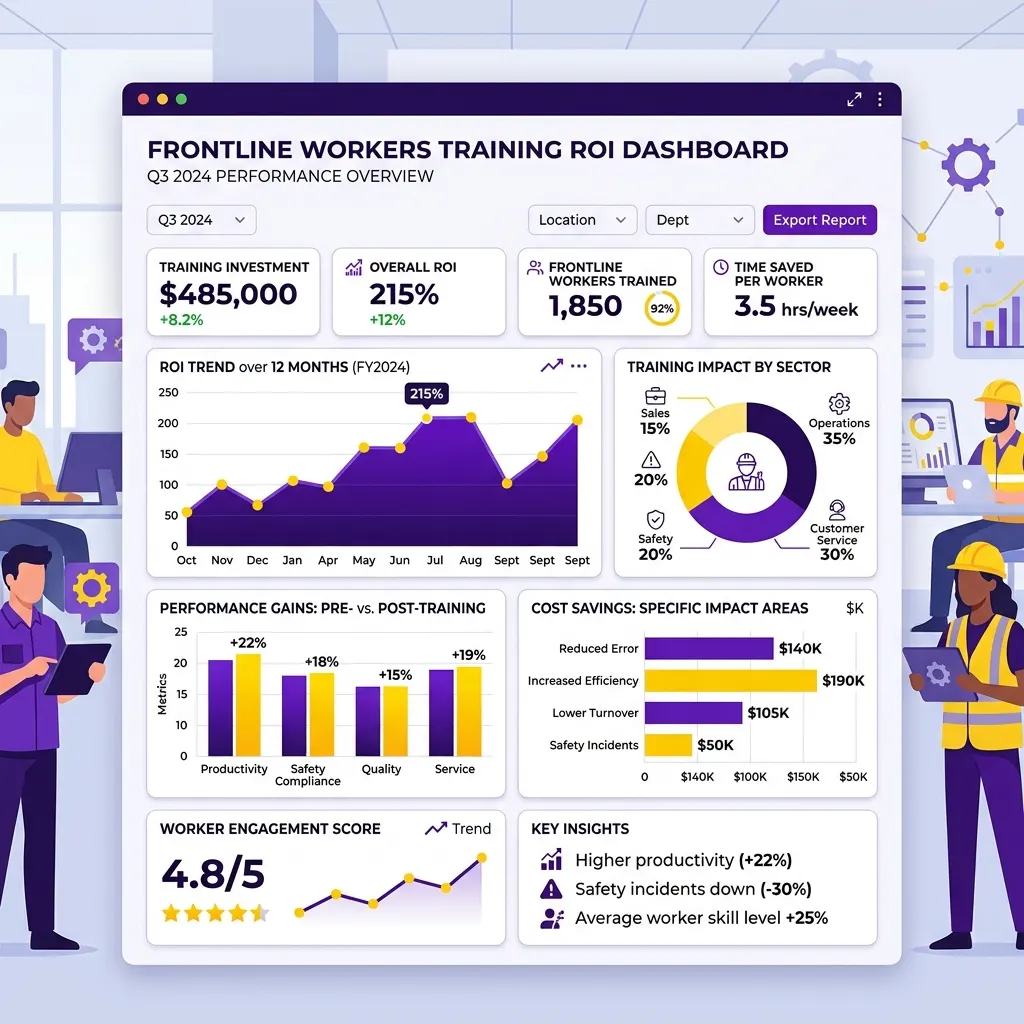
For most frontline-heavy organisations, this calculation yields ROI ratios of 300-800%, meaning every rupee invested in WhatsApp training returns ₹3-8 in measurable savings.
Presenting ROI to Leadership
When presenting training ROI to the C-suite, follow these principles:
Lead with the problem, not the solution. Start with the current cost of turnover, safety incidents, and slow onboarding - numbers that already appear in financial reports.
Use conservative estimates. Under-promise and over-deliver. Use the low end of expected improvement ranges. If the ROI is compelling even with conservative assumptions, the case is strong.
Show the timeline. Demonstrate that returns begin during the pilot phase, not years later. Turnover improvements can be measured within 90 days. Safety improvements within 6 months. Cost savings immediately.
Benchmark against alternatives. Compare WhatsApp training ROI against the status quo (continuing current approach) and against alternative investments (new LMS, additional trainers, expanded classroom programmes).
Propose a measurable pilot. Don't ask for full commitment upfront. Propose a 60-90 day pilot with defined success metrics. Let the data make the case for full deployment.
The Measurement Infrastructure
To calculate ROI, you need data. Here's the minimum measurement infrastructure:
Training data (from your WhatsApp training platform):
- Completion rates by worker, role, location
- Assessment scores by topic
- Engagement metrics (response rates, time-to-complete)
HR data (from your HRIS):
- Turnover rates by location, role, and tenure
- Time-to-productivity for new hires
- Training costs and headcount
Operations data (from your EHS and ops systems):
- Safety incident rates
- Quality metrics (defect rates, error rates)
- Customer satisfaction scores
- Production efficiency metrics
Connect these data sources to establish baseline measurements before launching WhatsApp training, then track changes after implementation.
Beyond the Numbers
ROI is the language of business cases. But the impact of effective frontline training extends beyond what spreadsheets capture.
Workers who feel supported and developed are more engaged. Engaged workers treat customers better. Better customer experiences drive revenue. Revenue growth funds further investment in the workforce.
It's a virtuous cycle, and it starts with training that actually reaches the people who need it most.
Measure the ROI. Present the business case. But remember that behind every data point is a worker who's either equipped to succeed or set up to fail. The training investment you make determines which.
Prove the ROI of your frontline training. Leap10x provides real-time analytics connecting training completion to operational outcomes - turnover, safety, productivity, and cost savings. Build the business case with real data. Start your free pilot today.
Frontline training
Training software built for deskless teams
Onboarding, SOPs, safety refreshers, and compliance evidence for workers with no corporate email and no company device — tracked by site, role, and shift.