The True Cost of Untrained Frontline Workers: A Data-Backed Breakdown for CFOs and CHROs

Quick answer
Every CFO knows the cost of training. Few have calculated the cost of not training.
Every CFO knows the cost of training. Few have calculated the cost of not training.
It's a blind spot, and it's expensive. When frontline workers don't receive adequate training, the costs don't show up on a single line item. They're scattered across dozens of budget categories: higher turnover, more safety incidents, increased customer complaints, slower onboarding, lower productivity, compliance fines, and quality defects. Individually, each seems manageable. Collectively, they represent one of the largest hidden operating costs in any frontline-heavy business.
This article puts numbers to those costs - not theoretical projections, but data drawn from industry research, government statistics, and real-world case studies. If you're a CFO, CHRO, or operations leader evaluating whether to invest in frontline training, this is the business case.
Cost Centre 1: Turnover
Frontline employee turnover is the most expensive consequence of inadequate training, and it's the most thoroughly documented.
The numbers are stark. Replacing a frontline worker costs approximately 40% of their annual salary according to Gallup. SHRM estimates the average cost at $4,700 per departure, though this rises significantly for skilled roles. For a company with 5,000 frontline workers and an industry-average turnover rate of 60%, that's potentially thousands of departures per year - each one carrying direct costs (recruiting, interviewing, hiring, onboarding) and indirect costs (lost productivity, team disruption, knowledge drain).
The connection between training and retention is direct. One in three restaurant employees cite inadequate training as a primary reason for leaving their jobs. More broadly, 94% of employees say they would stay at a company longer if it invested in their learning and development. And 76% report they would remain with an organisation if ongoing learning opportunities were available.
A Boston Consulting Group study found that when companies provide career advancement opportunities through training, they see a 17% increase in productivity, a 25% decrease in turnover, and a 41% decrease in absenteeism.
The calculation is straightforward: if investing in training reduces your turnover rate by even 10 percentage points, the savings in replacement costs alone can dwarf the training investment.
Cost Centre 2: Safety Incidents
In manufacturing, construction, logistics, and food service, untrained workers are unsafe workers.
The National Safety Council estimates the total cost of work injuries in the United States at $176.5 billion in 2023. According to the University of Tennessee, one of the primary underlying factors of workplace accidents is the lack of appropriate employee training.
Breaking down the per-incident costs:
- Direct medical costs: Hospital visits, treatment, rehabilitation
- Workers' compensation claims: Insurance premiums rise with incident frequency
- OSHA fines: Penalties for safety violations can reach tens of thousands of dollars per incident
- Lost production time: The injured worker's absence plus the disruption to the team
- Investigation and reporting costs: Internal and external investigation time
- Legal exposure: Lawsuits from injured workers or regulatory action
One manufacturing company that implemented WhatsApp-based safety microlearning reported a 40% reduction in safety incidents. At an average cost of $42,000 per recordable injury (Bureau of Labor Statistics data), eliminating even a few incidents per year generates substantial savings.
Cost Centre 3: Customer Experience Failures
For retail, hospitality, and food service businesses, every customer interaction is a moment of truth. Untrained frontline workers deliver inconsistent, sometimes damaging customer experiences.
The data is unambiguous: 59% of customers will stop doing business with a company after several bad experiences with frontline staff, and 17% will leave after just one negative interaction. Meanwhile, 70% of restaurant workers have never received customer service training, and 64% of consumers attribute poor experiences to poorly trained staff.
The lifetime value implications are significant. Losing a customer who would have spent a modest amount annually over a multi-year relationship translates to thousands in lost revenue per bad interaction. Multiply that across hundreds of locations and thousands of daily customer touchpoints, and the revenue impact of undertrained customer-facing staff becomes material.
Conversely, well-trained associates create measurably better outcomes. Organisations using modern training approaches have seen productivity improvements of 20% or more. IBM found that trained employees are at minimum 10% more productive. And employees who receive the right training are 6.3 times as likely to be fully engaged, which directly correlates with customer satisfaction scores.
Cost Centre 4: Slow Onboarding and Time-to-Productivity
Every day that a new hire spends in unproductive orientation is a day of paid labour with zero output. For industries with high hiring volume - retail, food service, logistics - onboarding inefficiency is a constant drag on the bottom line.
New hires take an average of 6-7 months to feel fully settled in their roles. For frontline roles, the relevant window is shorter - workers need to be functional within days, not months - but the principle holds: faster ramp-up equals faster value creation.
The costs of slow onboarding include:
- Trainer time: Every hour a supervisor spends onboarding a new hire is an hour they're not managing their existing team
- Buddy/shadow time: Pairing new hires with experienced workers reduces the productivity of both
- Error costs: New hires who aren't properly trained make more mistakes, leading to waste, rework, and customer complaints
- Extended ramp period: Each additional week of sub-par productivity represents lost output
Organisations that implement structured WhatsApp-based onboarding consistently report 20-30% reductions in time-to-productivity, because workers arrive at hands-on training with foundational knowledge already in place.
Cost Centre 5: Compliance Failures
Regulatory compliance isn't optional, and the penalties for non-compliance are increasing.
Food safety violations can result in restaurant closures, fines, and devastating publicity. Manufacturing safety violations carry OSHA penalties. Financial services compliance failures trigger regulatory action. Healthcare training gaps put patient safety at risk.
The cost of compliance training is predictable and manageable. The cost of compliance failure is unpredictable and potentially catastrophic. A single food safety incident can generate millions in liability. A single workplace fatality can result in criminal prosecution.
Yet 40% of frontline employees receive training only once a year or less. When compliance training is infrequent, outdated, and inaccessible, gaps are inevitable.
Digital training delivered through WhatsApp provides documented, timestamped proof that every worker completed every required module - the kind of audit trail that makes compliance officers and legal teams much more comfortable.
Cost Centre 6: Quality and Operational Efficiency
Untrained workers make more mistakes. More mistakes mean more waste, more rework, and more operational friction.
In manufacturing, defect rates directly correlate with training quality. In retail, inventory errors, merchandising mistakes, and POS system errors all trace back to inadequate training. In food service, incorrect preparation and order errors waste ingredients and alienate customers.
These costs are insidious because they're often accepted as "normal." But they're not normal - they're the tax you pay for insufficient training. Organisations that invest in continuous training consistently report lower defect rates, fewer errors, and smoother operations.
The Compound Effect: When All Costs Converge
The real impact of inadequate frontline training isn't any single cost centre - it's the compound effect of all of them operating simultaneously.
High turnover means you're constantly onboarding new workers who are more likely to make errors, cause safety incidents, and deliver poor customer experiences. Those poor experiences drive away customers, reducing revenue. Safety incidents drive up insurance costs and regulatory scrutiny. Compliance gaps create legal liability. And the cycle perpetuates itself because the workers who stay are burned out from covering for the constant churn.
Breaking this cycle requires investment in training. But the investment doesn't have to be massive. The shift from traditional to WhatsApp-based microlearning dramatically reduces per-worker training costs while improving every metric that matters.
Building the Business Case
For CFOs and CHROs evaluating training investment, here's a framework:
Step 1: Quantify your current costs.
- Annual turnover rate × cost per departure = turnover cost
- Annual safety incidents × average cost per incident = safety cost
- Customer complaints attributable to service quality = experience cost
- Average time-to-productivity for new hires = onboarding cost
Step 2: Estimate improvement potential.
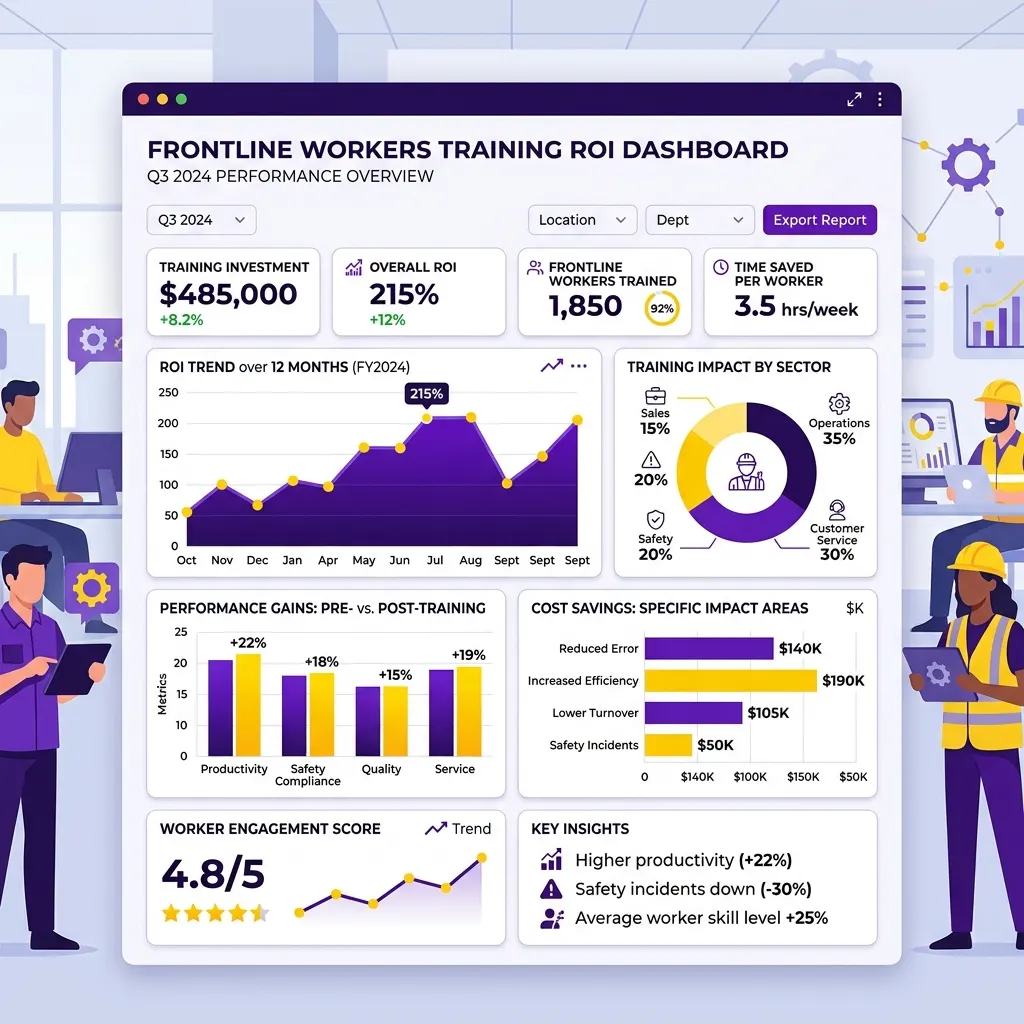
Based on industry benchmarks, WhatsApp-based frontline training typically delivers:
- 15-25% reduction in turnover
- 30-40% reduction in safety incidents
- 20-30% improvement in time-to-productivity
- 80%+ training completion (versus 15-20% baseline)
Step 3: Calculate net ROI.
Subtract the annual training platform cost from the total estimated savings. In most cases, the ROI is measured in multiples, not percentages.
The question for leadership isn't whether you can afford to train your frontline workers. It's whether you can afford not to.
Every untrained worker is a compounding liability. Every trained worker is a compounding asset. The data is clear. The math works. The only remaining question is execution.
Ready to see the ROI for your workforce? Leap10x helps frontline-heavy organisations deliver measurable training outcomes through WhatsApp - reducing turnover, improving safety, and accelerating productivity. Calculate your potential savings with a free assessment.
Frontline training
Training software built for deskless teams
Onboarding, SOPs, safety refreshers, and compliance evidence for workers with no corporate email and no company device — tracked by site, role, and shift.