Why Your Frontline Workers Ignore Push Notifications - And Why WhatsApp Messages Get 95% Open Rates
Quick answer
You've invested months building a training programme. The content is solid. The modules are well-designed.
You've invested months building a training programme. The content is solid. The modules are well-designed. You've even added gamification elements to make it engaging.
Then you hit send.
And nothing happens.
The push notification lands on your workers' phones alongside 47 other notifications they'll swipe away without reading. The email reminder sits unopened in an inbox they check once a week - if they have a corporate email at all. The LMS dashboard shows single-digit login rates.
Sound familiar? You're not alone. The training content isn't the problem. The delivery channel is fundamentally broken for frontline workers.
The Notification Graveyard: Why Push Notifications Fail Frontline Teams
Let's look at the numbers. The average smartphone user receives between 46 and 80 push notifications per day. Of those, research shows that the average opt-in rate for push notifications across industries hovers around 60%, but actual engagement - meaning the user taps and takes action - drops to just 7–10%.
For frontline workers, the situation is worse. These are people whose phones are constantly buzzing with personal messages, social media alerts, news updates, and app promotions. A training notification from an app they downloaded reluctantly during onboarding simply can't compete for attention.
Here's why push notifications fail for deskless workers specifically:
1. App fatigue is real. Before a push notification can work, the worker needs to have downloaded the training app, created an account, set a password, and kept the app installed. Research shows that 25% of downloaded apps are used only once and then abandoned. For frontline workers juggling personal phones with limited storage, a training app is often the first to go.
2. Notifications get bulk-dismissed. When a worker picks up their phone during a break, they see a wall of notifications. The instinct is to clear them all with one swipe, not to carefully evaluate each one.
3. Timing is terrible. Push notifications arrive when the system sends them, not when the worker is ready to learn. A safety training reminder that pops up during a customer interaction is worse than useless - it's an annoyance.
4. No personal connection. A generic "Complete your training module" push notification feels corporate, impersonal, and easy to dismiss. There's no social accountability, no conversational thread, and no sense that someone real is on the other end.
Email fares even worse. Research shows email open rates for employee communications average around 20–25%. For frontline workers specifically, 83% don't even have corporate email accounts, making email-based training delivery impossible for the majority of your workforce.
Why WhatsApp Changes the Equation
WhatsApp messages achieve open rates above 95%. Not because WhatsApp has magic technology, but because of something far more powerful: behavioural integration.
The average WhatsApp user opens the app between 23 and 25 times per day. In India, that number climbs even higher. WhatsApp isn't just a communication tool - it's a habit. It's the first app people check in the morning and the last before bed.
When a training message arrives on WhatsApp, it sits alongside messages from family, friends, and work groups. It doesn't require opening a separate app. It doesn't need a login. It doesn't feel like "corporate training." It feels like a message.
That single distinction - training that feels like communication rather than compliance - changes everything about how frontline workers engage.
Here's what makes WhatsApp structurally different from push notifications:
Zero friction access. Workers don't download a new app, create an account, or remember a password. They already have WhatsApp. Training arrives in their existing chat flow.
Conversational format. WhatsApp training feels like a dialogue, not a broadcast. Workers receive a question, think about it, reply, and get instant feedback. This interactive loop creates active learning rather than passive content consumption.
Social proof and accountability. When workers see training messages in the same app where they communicate with their supervisor and team, there's an implicit sense that this matters. It's not hidden away in a separate system that nobody checks.
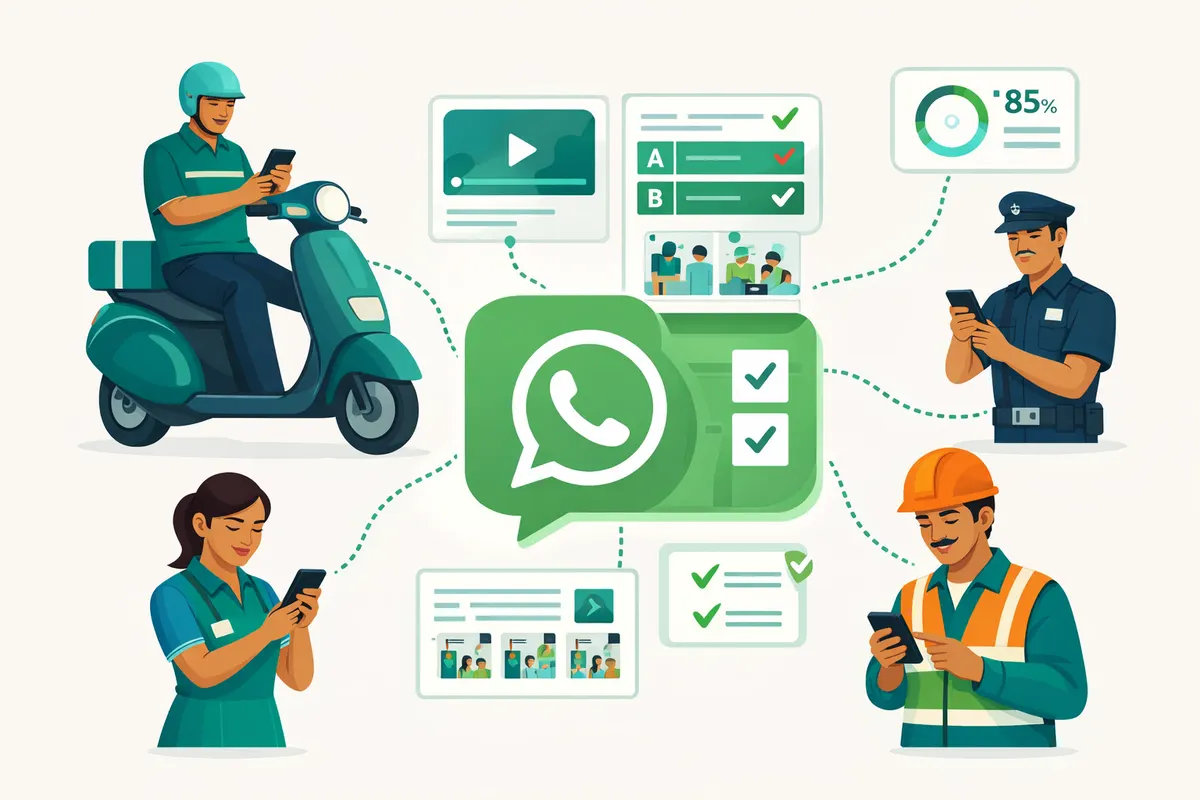
Multimedia richness. WhatsApp supports text, images, videos, documents, voice notes, and interactive buttons - all within the same conversation. A safety training module can include a 30-second video demonstration, followed by a quiz, followed by a downloadable checklist, all without leaving the chat.
Read receipts and tracking. Unlike push notifications, WhatsApp provides visibility into whether messages were delivered and read. Training platforms built on WhatsApp can track exactly who viewed each module, who completed each quiz, and who needs a follow-up.
The Data Behind the Shift
Organisations that have moved from app-based to WhatsApp-based training report consistent improvements across every engagement metric:
- Completion rates jump from 15–20% to 80%+. When training meets workers where they already are, completion becomes the default behaviour rather than the exception.
- Response times drop dramatically. Workers respond to WhatsApp training prompts within minutes, versus days (or never) for push notifications.
- Knowledge retention improves. The conversational, question-first format of WhatsApp training promotes active recall - the single most effective learning technique according to cognitive science.
- Manager visibility increases. When training lives on WhatsApp, supervisors can see who's engaged and who's falling behind without logging into a separate dashboard.
A large Indian manufacturing firm that switched from an app-based LMS to WhatsApp-delivered microlearning saw a 40% reduction in safety incidents and a 30% improvement in operational efficiency - largely because workers were actually completing the training for the first time.
When Push Notifications Do Work (And When They Don't)
To be fair, push notifications aren't universally useless. They work well for desk-based employees who have company devices, dedicated training time, and the habit of checking work apps regularly.
But for frontline workers - the 80% of the global workforce who are deskless - push notifications fail because they require behaviours that don't exist in the frontline work context: regular app usage, uninterrupted screen time, and the mental bandwidth to context-switch from work to training.
The question for L&D leaders isn't "how do we make push notifications better?" It's "how do we reach workers through channels they already use every day?"
Making the Switch: What to Expect
Transitioning from push notification-dependent training to WhatsApp-based delivery doesn't require rebuilding your entire programme. Here's the practical path:
Start with one use case. Pick your lowest-performing training programme - the one with the worst completion rates - and deliver it through WhatsApp instead. Measure the difference.
Convert existing content. Your current training materials don't need to be thrown away. They need to be reformatted into chat-friendly micro-modules: short text, questions, images, and brief videos.
Automate the journey. Use a training platform that automates message sequencing, so each worker receives the right content at the right time without manual effort from trainers.
Track and iterate. WhatsApp-based platforms provide granular analytics - completion rates, quiz scores, engagement patterns - that you've likely never had for your frontline teams.
The Bigger Picture: Meeting Workers Where They Are
The fundamental principle behind WhatsApp's training effectiveness isn't technological. It's human.
Frontline workers aren't resistant to learning. Research consistently shows that 94% of employees would stay at a company longer if it invested in their development. The problem is access, not appetite.
When you deliver training through a channel that requires downloading a new app, creating yet another login, and navigating an unfamiliar interface, you're asking workers to overcome friction before they can even begin learning. Most won't bother - not because they don't want to learn, but because the barriers are too high relative to the perceived value.
WhatsApp removes those barriers entirely. Training becomes as natural as reading a message. And when training is easy to access, something remarkable happens: people actually complete it.
The 95% open rate isn't a WhatsApp feature. It's a behavioural reality. And for L&D teams struggling with frontline engagement, it's the most powerful lever available.
Stop sending training to channels your workers ignore. Leap10x delivers microlearning directly through WhatsApp - no app downloads, no logins, no push notifications to dismiss. See completion rates your LMS never achieved. Start a free pilot today.
Frontline training
Training software built for deskless teams
Onboarding, SOPs, safety refreshers, and compliance evidence for workers with no corporate email and no company device — tracked by site, role, and shift.