Nudge-Based Learning via WhatsApp: How 2-Minute Reminders Drive 50% More Behavior Change
Quick answer
In 1885, German psychologist Hermann Ebbinghaus ran a series of memory experiments that L&D professionals are still grappling with 141 years later.
Your Training Is Forgotten Before the Shift Ends
In 1885, German psychologist Hermann Ebbinghaus ran a series of memory experiments that L&D professionals are still grappling with 141 years later. His finding - now called the Ebbinghaus Forgetting Curve - showed that people forget roughly 70% of new information within 24 hours and up to 90% within a week.
That safety training your factory workers completed on Monday? By Friday, most of it is gone. That compliance refresher your retail staff sat through? It evaporated before they reached the shop floor.
Traditional training treats learning as an event - a workshop, a course, a module. But behavioral science tells us that lasting behavior change doesn't come from events. It comes from repeated, well-timed, low-friction prompts that nudge people toward the right action at the right moment.
This is where nudge theory meets WhatsApp - and the results are transforming how companies train frontline workers.
What Is Nudge-Based Learning (And Why Does It Work)?
Nudge theory was popularized by Nobel Prize-winning economist Richard Thaler and legal scholar Cass Sunstein in their 2008 book Nudge: Improving Decisions About Health, Wealth, and Happiness. The core idea: you can influence behavior more effectively by making the desired action easy and timely, rather than by forcing compliance through mandates.
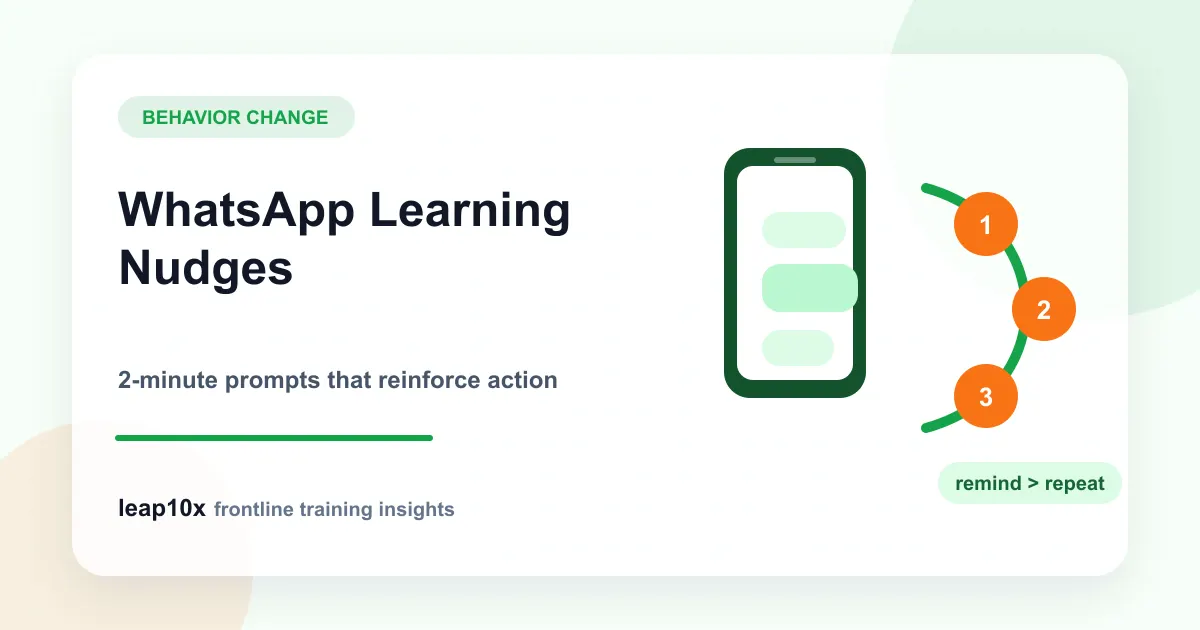
A nudge is a small environmental cue that guides someone toward a better decision without restricting their choices. In workplace learning, nudges look like:
- A 2-minute WhatsApp reminder about proper PPE usage sent at the start of a shift
- A quick quiz on food safety protocols delivered right before a restaurant opens
- A short video refresher on customer handling sent before peak retail hours
- A single-question knowledge check on compliance rules sent weekly
The research behind nudge-based learning is robust. A peer-reviewed analysis of over 100 studies found that nudges lead to statistically significant behavior change 62% of the time, with a median behavior change of 21%. That's not a marginal improvement - that's a fundamental shift in how people act on the job.
The Data Behind Nudge-Based Training
The evidence isn't anecdotal. Major organizations have tested nudge-based approaches and measured real results:
Google's "Whisper Courses"
Google developed a program called "whisper courses" - short, email-based nudges sent to managers over several weeks. The result was a 33% increase in psychological safety within teams. No workshops. No mandatory training days. Just well-timed, bite-sized prompts delivered where managers already worked.
Deloitte's Compliance Nudges
When Deloitte switched from periodic compliance training to weekly nudges, they saw a 31% jump in compliance scores. The nudges weren't complex - they were short, contextually relevant, and progressively built on earlier learning. The key factors: personalized timing, connection to real work scenarios, and clear value for the learner.
Spaced Repetition Research
Students and employees who review information at strategic intervals through spaced repetition boost their recall by up to 150% compared to those who study in massed sessions. Research shows people need between 18 and 254 days of repeated action to build a single habit. Nudges provide exactly this kind of repetition - without overwhelming the learner.
Why WhatsApp Is the Perfect Nudge Channel for Frontline Workers
Here's where most nudge-based learning strategies fall apart: they rely on email, desktop notifications, or LMS platforms that frontline workers never open.
Consider the numbers:
- WhatsApp has a 98% message open rate in India
- The average knowledge worker checks messaging apps every 6 minutes
- 2.7 billion people use WhatsApp globally
- 90% of Indian frontline workers use WhatsApp daily
- Email open rates for corporate training hover at 20-30%
When a safety reminder arrives as a WhatsApp message, it doesn't compete for attention - it's already in the stream of communication workers engage with dozens of times per day. There's no login, no app download, no password to remember. The nudge appears exactly where the worker is already looking.
This is the fundamental difference between nudge-based learning on WhatsApp versus nudges on platforms workers rarely check. The channel isn't incidental - it's the mechanism that makes the nudge work.
Building a WhatsApp Nudge Learning Program: A Step-by-Step Guide
Step 1: Identify Your Behavior Change Goals
Don't start with content - start with the behavior you want to change. Examples:
- Reduce safety incidents by reinforcing PPE compliance daily
- Improve customer satisfaction by nudging service standards before shifts
- Increase compliance scores by sending weekly regulatory reminders
- Accelerate onboarding by spacing out key knowledge across the first 30 days
Each nudge should target one specific behavior, not a broad topic.
Step 2: Design Your Nudge Calendar Using Cognitive Science Intervals
Based on spaced repetition research, here's an optimal nudge calendar for any training topic:
- Day 1: Initial micro-learning module (3-5 minutes) + immediate reinforcement nudge
- Day 2: First spaced repetition nudge - a quick quiz or scenario question (24-hour interval)
- Day 8: Memory consolidation nudge - a short refresher with a real-world example (7-day interval)
- Day 17: Long-term retention nudge - a situational challenge or case study (16-day interval)
- Day 35: Mastery verification nudge - a final assessment to confirm knowledge stuck (35-day interval)
This 5-touch sequence takes less than 15 minutes of total learner time spread across five weeks - but it can boost retention by up to 150% compared to a single training session.
Step 3: Keep Each Nudge Under 2 Minutes
The golden rule of nudge-based learning: if it takes longer than 2 minutes, it's not a nudge - it's a micro-course. Nudges should be:
- One question ("Before you start your shift: Which PPE item is mandatory in Zone C?")
- One tip ("Quick reminder: Always verify the customer's identity before processing a refund")
- One visual (A 30-second video showing the correct machine lockout procedure)
- One story ("Last week, a colleague in Pune prevented a safety incident by…")
Step 4: Personalize by Role and Context
A nudge about forklift safety is irrelevant to a retail associate. A customer handling tip is useless for a warehouse operator. Effective nudge programs segment workers by role, location, shift, and skill level.
Platforms like Leap10x make this practical - you can create one training module and deploy it to different worker groups via WhatsApp, with the AI automatically adjusting content and language based on the audience.
Step 5: Measure Behavior Change, Not Just Completion
The whole point of nudge-based learning is behavior change - not course completion certificates. Track:
- Quiz accuracy over time (Are workers retaining knowledge across the spaced intervals?)
- Operational KPIs (Have safety incidents decreased? Has customer satisfaction improved?)
- Engagement patterns (Which nudges get opened first? Which get ignored?)
- Behavioral indicators (Are workers applying the nudged behavior on the job?)
Common Mistakes to Avoid
Nudge Fatigue
Sending too many nudges too frequently turns helpful prompts into noise. Research suggests that more than 3-4 nudges per week per worker is the tipping point where engagement drops. Quality and timing matter more than volume.
Generic Content
A nudge that says "Remember to follow safety protocols" is too vague to change behavior. Effective nudges are specific: "Before operating the press brake today, confirm the light curtain is active - tap YES to confirm."
Ignoring the Forgetting Curve
Sending all your training content in Week 1 and hoping it sticks ignores everything we know about memory. Space your nudges deliberately using the Day 1-2-8-17-35 framework.
Not Closing the Loop
Nudges without measurement are just messages. Always include a response mechanism - a quiz answer, a confirmation tap, a rating - so you can track whether the nudge landed.
The Bottom Line
Frontline workers don't need more training. They need better-timed, better-placed, better-designed prompts that reinforce the right behaviors at the right moments. Nudge-based learning via WhatsApp delivers exactly that - combining Nobel Prize-winning behavioral science with the communication channel workers already use every day.
The numbers speak for themselves: 62% behavior change rate, 150% recall improvement with spaced repetition, 98% message open rates on WhatsApp. When you put these together, you get a training approach that doesn't just inform - it transforms.
Ready to launch nudge-based learning for your frontline workforce? Leap10x delivers automated WhatsApp nudge sequences in 70+ languages - turning 2-minute reminders into lasting behavior change. Start your free pilot today.
Microlearning
Turn your SOPs into 3-minute modules
Upload a PDF, deck, or video and Leap10x's AI builds micro-modules with quizzes and spaced-repetition schedules — delivered where your frontline already is.