Training Completion Rate Benchmarks (2026): What's Normal, What's Possible, and How to Get There
Quick answer
Training completion rate benchmarks by delivery channel and industry, why frontline rates collapse, and 7 proven ways to raise completion without mandates.
Training completion rate is the percentage of assigned learners who finish a course or program. Benchmarks vary enormously by delivery channel: desktop LMS programs for frontline workers commonly complete at 20–30%, mobile app-based programs at 40–60%, and chat-delivered microlearning (WhatsApp) at 85%+. Channel friction, not content quality, explains most of the spread.
Completion rate is the most-watched number in L&D and the least-contextualized. "Is 60% good?" has no answer without knowing who the learners are and what they had to do to start the course. This page gives you working benchmarks and the levers that actually move the number.
Benchmarks by delivery channel (frontline populations)
| Delivery model | Typical completion | Why |
|---|---|---|
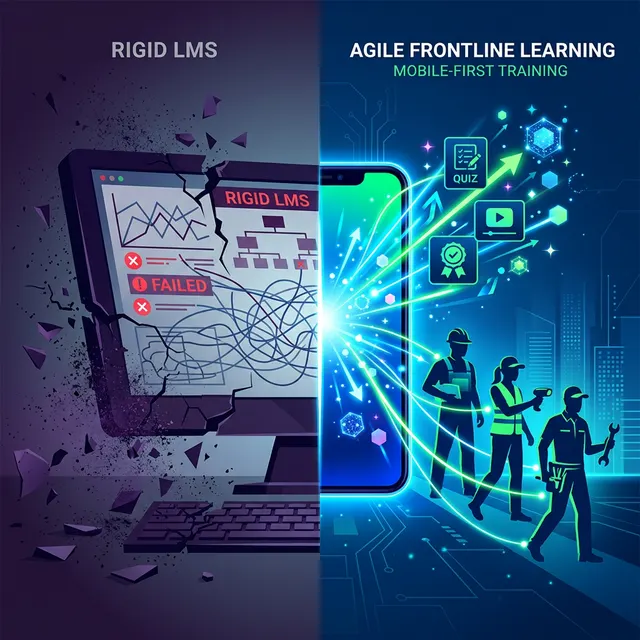
| Desktop LMS with email login | 20–30% | No desk, no email, shared kiosks - the access wall |
| Mobile LMS app (install + login) | 40–60% with enforcement | App fatigue: 79% of frontline workers resist another app |
| SMS/link-based micro-courses | 50–70% | Low friction, but links still leave the message |
| WhatsApp-native microlearning | 85%+ (Leap10x program norm) | Zero install, zero login, arrives where workers already are |
| Instructor-led (classroom) | 90%+ attendance, but see note | Attendance ≠ attention; and scheduling cost caps frequency |
Two context notes. First, desk-based corporate eLearning benchmarks run higher than the frontline LMS row - the 20–30% figure is specifically the deskless story. Second, classroom "completion" measures bodies in chairs; retention a month later tells a much sadder story.
What actually drives completion (ranked)
1. Access friction. Every step between "training assigned" and "learning happening" - app installs, passwords, portal navigation - sheds learners. This single variable explains the table above. The fix is structural, not motivational: deliver on a channel with zero new steps. (Why frontline workers don't complete training unpacks this.)
2. Unit length. Completion falls as unit length rises. 3–5 minute units complete; 45-minute modules don't - 63% of frontline workers explicitly want shorter training. Decompose before you decorate.
3. Nudges. Automated reminders on a high-open-rate channel recover 10–20 points of completion. WhatsApp messages get ~95%+ open rates versus single-digit engagement for many push notifications - the delta we documented here.
4. Language. Training in a worker's second language quietly suppresses completion and comprehension. One-click translation into 70+ languages removes the excuse for English-only programs.
5. Manager visibility. When site managers see live dashboards - and their site's number - completion becomes an operations metric. Social proof beats mandates.
6. Relevance and timing. Training that lands the week it's needed (launch, audit, season) completes; evergreen libraries languish.
7. Recognition. Certificates and shout-outs - cheap, and they work, especially where completion feeds recognition programs.
Stop optimizing completion alone
A warning from the field: completion is a reach metric, not a learning metric. It's the necessary first gate - nothing else can happen without it - but the numbers that justify budgets live downstream: assessment scores, retention at 30 days, and behavior change on the floor. Our guide to measuring beyond completion rates covers the full metric stack; the short version is: report completion → comprehension → application, in that order, and never stop at the first.
A 30-day completion turnaround plan
- Week 1: Measure honestly. Completion = completed ÷ assigned (not ÷ started). Segment by site and channel.
- Week 2: Take your worst-completing mandatory program. Split it into 3–5 minute units. Change nothing else; re-measure.
- Week 3: Move delivery to WhatsApp for one pilot region - same content, zero-login channel, automated nudges.
- Week 4: Compare regions, then scale the winner. Expect the channel move to dwarf every content tweak you've tried.
FAQ
What is a good training completion rate?
For frontline workforces: treat 80%+ as good, 90%+ as excellent. If you're at 20–40%, you have a channel problem, not a content problem.
How do you calculate training completion rate?
Completed learners ÷ assigned learners × 100, within a defined window. Beware vendors quoting completed ÷ started - it hides the access wall.
Why are frontline completion rates so low on LMS platforms?
No desk, no company email, shared devices, and no schedule slack - the LMS assumes all four. Details: why your LMS fails frontline workers.
Does mandating training fix completion?
It raises the number and lowers the learning - clicked-through compliance. Removing friction raises both.
See what 85%+ completion looks like on your own content. Book a Leap10x demo - we'll convert one of your courses to WhatsApp microlearning live.
WhatsApp LMS
Everything an LMS does — inside WhatsApp
Course libraries, enrolment, assessments, certificates, and audit-ready completion logs, with WhatsApp as the learner interface instead of a portal nobody opens.