Frontline Employee Training in the United States: The Hourly Workforce Playbook (2026)
Quick answer
How US retailers, restaurants, warehouses and healthcare operators train hourly frontline employees in 2026 - turnover math, texting vs apps, compliance, and a 30-day rollout plan.
Frontline employee training in the US is a turnover problem wearing a training costume. Retail turnover runs around 60% a year and restaurants clear 70%, which means the average operator retrains most of its floor every twelve months. The training that survives that churn is short, mobile, delivered to the phone the worker already carries, and verifiable in a dashboard. Everything else gets skipped between shifts.
This guide is written for the people who own that problem in American operations: VP of Store Ops, Director of Training at a restaurant group, the HR lead at a 3PL warehouse, the education coordinator at a home-health agency. It covers what makes the US frontline different from the office workforce, what the current data says about why training doesn't land, the delivery choices that matter (SMS, WhatsApp, apps, kiosks), the compliance layer you can't skip, and a 30-day plan you can run without a new headcount.
Who counts as "frontline" in the US, and how many there are
The US has roughly 80 million hourly workers. Not all of them are frontline, but the overlap is large: retail associates and cashiers, quick-service and full-service restaurant crew, warehouse pickers and forklift operators, delivery drivers, hotel housekeepers, home health aides and CNAs, security officers, manufacturing line workers, and the growing gig and staffing-agency layer that floats between all of them.
What they share is not a job title. It's a set of constraints that most corporate training quietly assumes away:
- No company email, no company laptop. Training that requires a login ceremony dies at the login.
- Paid by the hour. Every minute of training is either unpaid (a legal risk under the FLSA) or comes off the labor budget. Fifteen minutes matters.
- Scheduled in shifts, often variable. There is no "Tuesday at 2pm" when the whole team is free.
- High turnover. Onboarding isn't a project; it's a permanent production line.
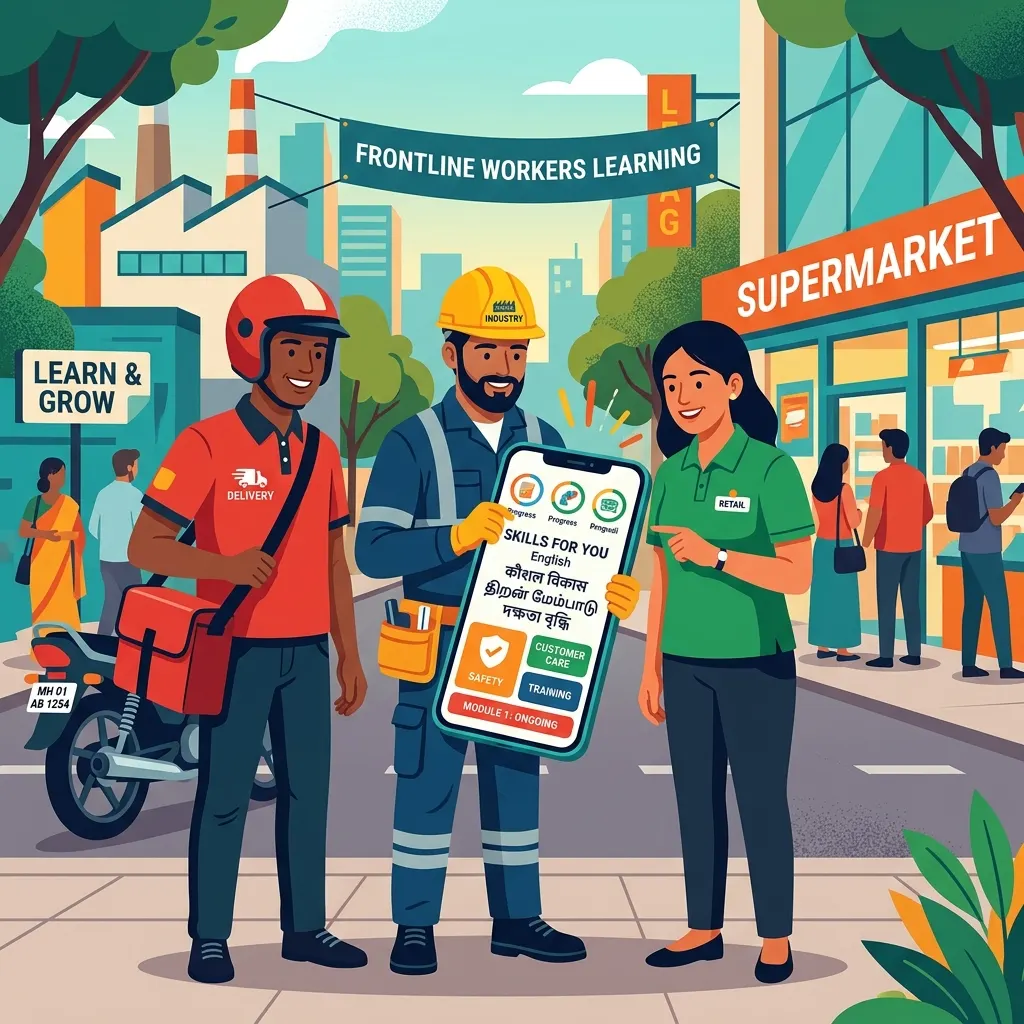
- Multilingual. Spanish is the first language of a large share of construction, hospitality, food processing and agriculture crews. We cover this in depth in the companion piece on bilingual training for Spanish-speaking frontline workers.
If you want the broader definition and global numbers, start with what is a frontline worker and the deskless workforce statistics roundup.
What the 2026 data says about why frontline training misses
Axonify's 2026 Frontline Operations Report surveyed 1,594 frontline employees, managers and corporate leaders across US retail, food service, hospitality and grocery. Three numbers from it should reshape how you think about training delivery:
- 87% of leaders believe information reaches frontline workers effectively. Only 56% of workers agree. That 31-point gap is the whole problem in one line. Headquarters thinks the message landed. The floor says it didn't.
- 59% of frontline workers name their manager as their primary source of operational communication. Every launch, every SOP change, every new-hire orientation runs through one overloaded person per location. When that manager is short-staffed, training frequency drops first.
- 38% of frontline employees say tasks regularly require rework - not because they lack skill or motivation, but because the instructions arrived incomplete or not at all.
The same report found that 53% of frontline workers already have a personal smartphone accessible during work and 58% find digital tools convenient when they can use them. The device problem that blocked mobile training a decade ago is mostly gone. The remaining problem is design.
The turnover math that should drive your training budget
Let's make the cost concrete with conservative US numbers.
A 200-store specialty retailer with 12 hourly associates per store has 2,400 frontline staff. At 60% turnover, that's 1,440 new hires a year. If each one takes 19 days to become "shift-ready" - the average Crunchtime reports for restaurant operators, who say they want it down to 12 - and a partially productive new hire costs the business roughly $150 a day in lost sales, coaching time and errors, the ramp alone costs about $4.1 million a year.
Cut ramp time from 19 days to 12 and you save around $1.5 million a year. That's before counting the retention effect: workers who get a structured first 30 days are measurably less likely to quit in the first 90, which is where most frontline attrition happens. We've written up that early-attrition window in the first 90 days and new-hire attrition, and the replacement-cost model in the true cost of replacing a frontline worker.
The point isn't the specific dollar figure. It's that in the US frontline economy, the return on training is measured in ramp days and 90-day retention, not in course completions.
Delivery: SMS, WhatsApp, apps, kiosks, or the POS?
This is where the US differs from almost every other market we work in. In India, Brazil, Nigeria or Spain, WhatsApp is the default channel for the entire workforce. In the US, the picture is mixed, and the right answer depends on who you employ.
SMS is universal. Every hourly worker has a number that receives texts. It's the safest baseline for reminders, links to a lesson, and completion nudges. Its weaknesses are cost per message at scale, no rich media inside the message itself, and carrier filtering of anything that looks like marketing (10DLC registration is now mandatory for business texting in the US).
WhatsApp has over three billion users globally and is growing fast in the US, especially among Hispanic, South Asian, West African and Caribbean communities and among any workforce with family abroad. In hospitality, construction, food processing, home care and warehousing in states like California, Texas, Florida, New York and New Jersey, WhatsApp adoption on the floor is often already high - your crews are probably running shift swaps on it right now. The advantage over SMS: rich media (video, audio, image cards, interactive quizzes) inside a chat the worker already opens dozens of times a day, and message costs that are typically lower than SMS for utility traffic.
Dedicated employee apps work when you can mandate installation and when the app does more than training (scheduling, pay stubs, shift swaps). If the app exists only for training, expect low installs. We've looked at the data on this in why frontline workers don't download employer apps.
Kiosks, POS terminals and shared tablets are useful for compliance modules that must happen on the clock and on company property. They don't work for spaced reinforcement, which needs to reach the worker on their own time and device.
Our recommendation for US operators: run a channel-agnostic model where the same 3-minute lesson can go out over WhatsApp where adoption is high, SMS with a passwordless link where it isn't, and a QR code in the break room for walk-up access. Let the workforce pick. The completion data will tell you within two weeks which channel each site prefers.
Leap10x delivers lessons over WhatsApp, email and passwordless magic links on every plan, with SMS and authenticated QR-code access on Enterprise plans - no app install, no password. For a US operator that means one course, three doors in.
What to train, and in what order
US frontline training programs tend to fail from overreach. They try to put the whole employee handbook into onboarding week. Here's the sequence that works for hourly teams.
Day 0–1: Preboarding and the first shift
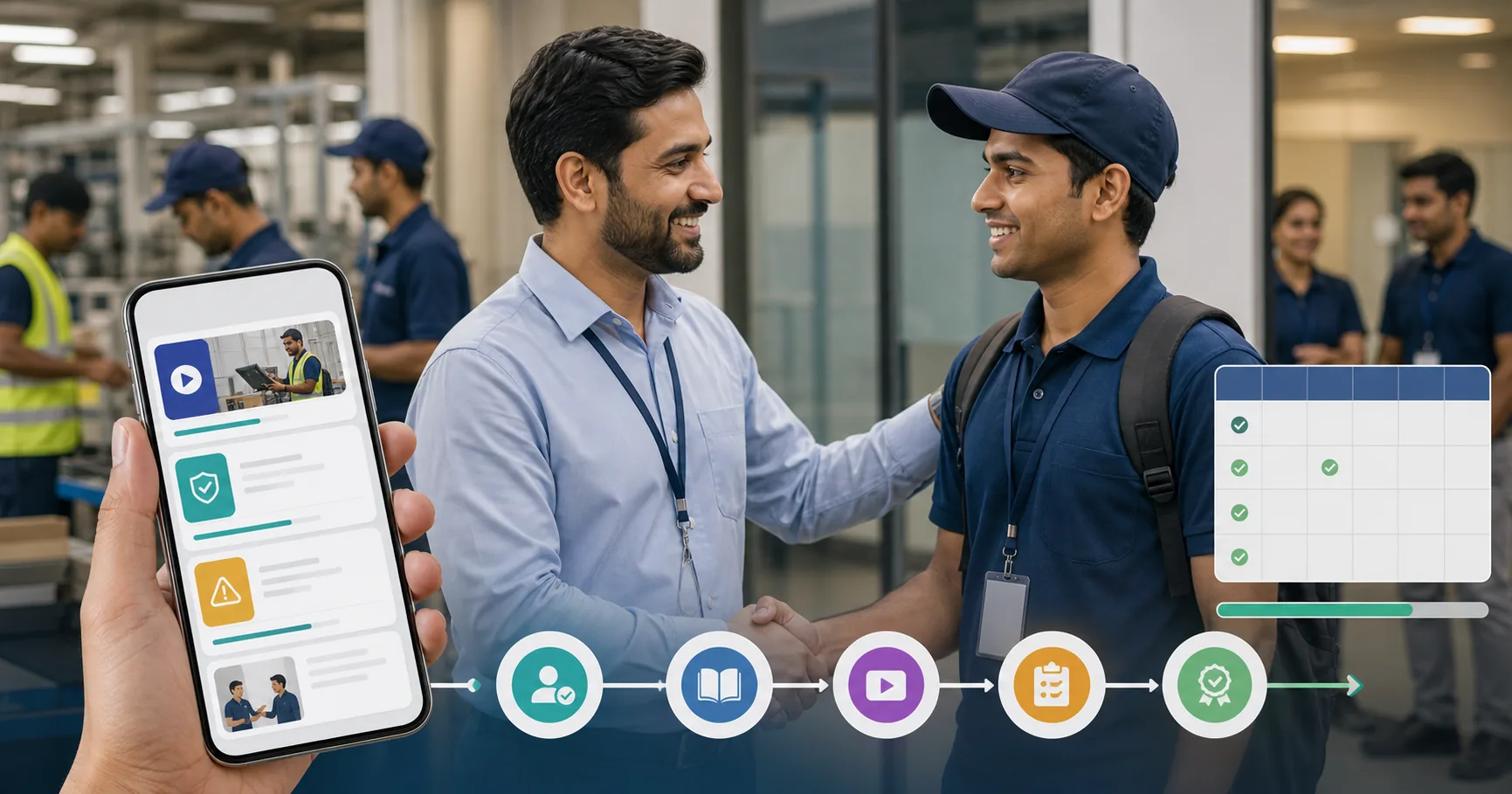
Send the first three lessons before the first shift: who we are, what your first day looks like, and the two safety rules that matter most in this building. This cuts first-day no-shows and makes day one feel less like a fire hose. See preboarding on WhatsApp to reduce joining no-shows.
Week 1: Compliance you're legally required to deliver
- OSHA-mandated safety training for the hazards in that role - Hazard Communication, PPE, forklift certification, lockout/tagout, bloodborne pathogens in healthcare. OSHA requires training in a language and vocabulary the worker understands. Our LOTO training guide and fire safety training guide break down two of the most-cited ones.
- Food handler requirements in food service (state and county rules vary).
- Harassment prevention - mandatory in California, New York, Illinois, Connecticut, Delaware, Maine and Washington, with specific hour and frequency requirements. Leap10x is ISO 27001:2022 certified and exports completion records per worker, which is what your employment counsel will ask for.
- Workplace violence prevention - California's SB 553 requires a written plan and employee training for most employers as of July 2024, and healthcare has its own federal and state layers. De-escalation training is the operational half of that requirement.
Weeks 2–4: Role skills, in the flow of work
Product knowledge, POS procedures, upselling, cleaning standards, picking accuracy, patient-handling technique - delivered as one 3-to-5-minute lesson per shift, not a two-hour module. A retail associate who gets a 4-minute "new denim fit guide" on Thursday morning before the weekend floor set is trained. The same content in a 45-minute LMS course assigned "due in 30 days" is not.
Ongoing: Reinforcement and refreshers
The forgetting curve is real and expensive. Without reinforcement, most procedural knowledge decays within weeks. A weekly two-question quiz per topic keeps it alive and gives you a live readiness score per location. The science is in spaced repetition for frontline training.
The US compliance layer: what training records must show
If a wage-and-hour attorney, an OSHA compliance officer, a state labor investigator or a plaintiff's lawyer ever asks for your training records, they want four things per worker: what was delivered, when, whether the worker demonstrated understanding (a quiz score), and in what language. Sign-in sheets don't provide the last two.
Two US-specific points:
- Paid time. Under the FLSA, required training is generally compensable working time. Mobile training doesn't change that; it just makes it easier to keep sessions to 5 minutes and to timestamp them. Build the training minutes into the schedule and say so in the policy.
- Personal devices. BYOD training is legal and common but your policy should address data charges, off-the-clock use and privacy. We've covered the framework in BYOD training compliance for deskless workers - the Indian context, but the policy structure translates directly.
Leap10x holds ISO 27001:2022 certification, is GDPR-aligned, encrypts data with AES-256 at rest and TLS 1.2+ in transit, and offers US data residency on Enterprise plans. Customer content is never used to train public AI models.
The manager problem, and how to route around it
Recall that 59% of frontline workers get their operational information from their manager. Every training program that depends on the manager to deliver it inherits that manager's capacity. In US retail and restaurants, that manager is often covering a shift, closing the register and handling a callout at the same time.
The fix isn't "train the managers to train better." It's to take the delivery burden off them and hand them the visibility instead:
- Lessons go out automatically by role and hire date.
- Reminders go out automatically to the people who haven't completed.
- The manager sees a per-person readiness list on their phone: who's cleared food safety, who hasn't done the new promo module, who scored low on the allergen quiz.
- Coaching time gets spent on the gaps the data surfaces, not on reading a PowerPoint to six people in a break room.
That's the Kirkpatrick model applied to a Tuesday: Level 1 and 2 are automated, and the manager's hour goes to Level 3 - is the behavior on the floor actually changing?
Where the US market is heading
Three shifts worth planning for:
AI-generated content is collapsing production cost. A regional grocer's training team used to need weeks and an agency to turn a new food-safety SOP into a course. Upload the PDF to an AI course generator today and you have lesson cards, quiz questions and a Spanish version in minutes. Leap10x's own numbers: under 10 minutes from raw document to a live, multilingual course. The bottleneck moves from "producing content" to "deciding what's worth teaching." Our guide on converting PDFs and SOPs into microlearning covers the workflow.
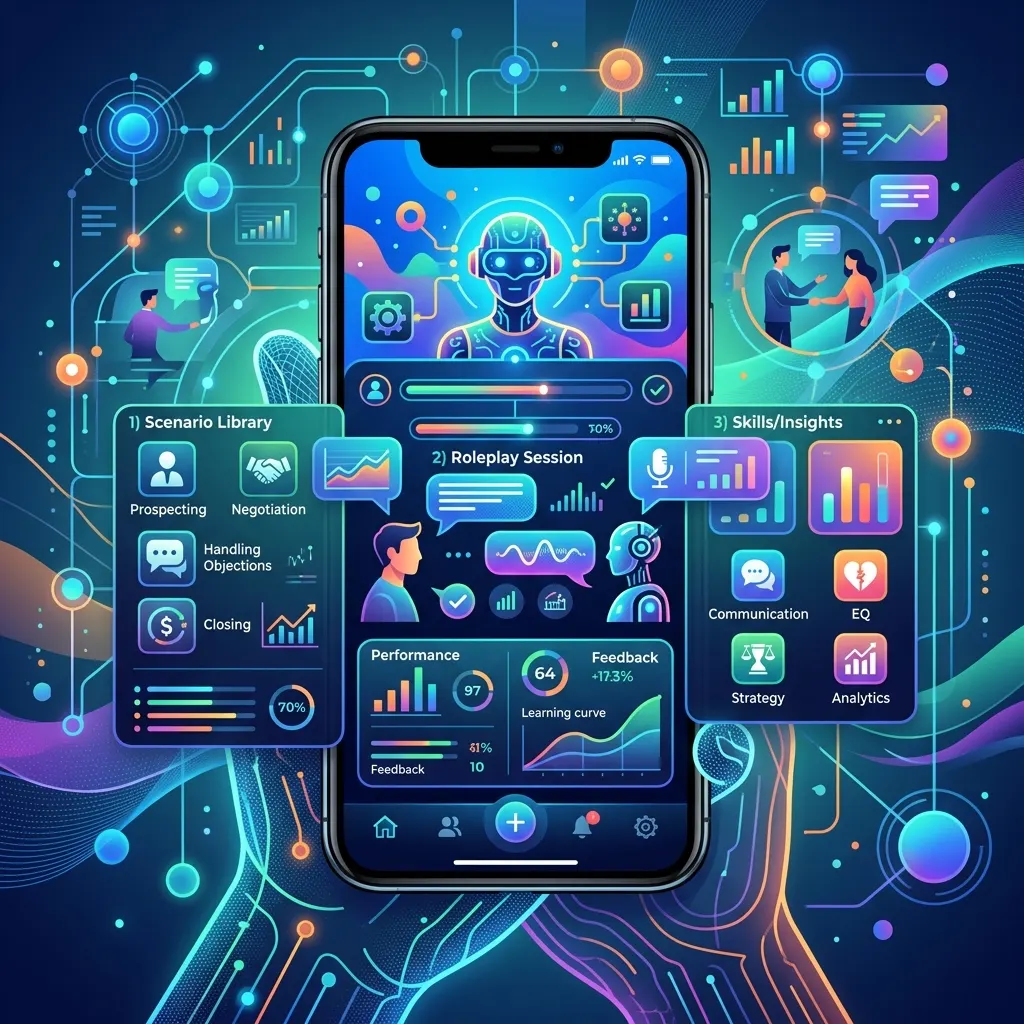
Practice, not just knowledge. Contact centers, bank branches, pharmacies and retail floors are moving from "did you read the script" to "can you handle this conversation." AI roleplay - by chat or voice - lets a new hire rehearse an angry-customer refund or a suspicious-transaction escalation before it's real. See what is AI roleplay training.
AI literacy for hourly workers. The 2026 Engagedly data point that 86% of frontline workers believe they need AI training but only 14% have received any applies squarely to the US. Self-checkout, computer-vision loss prevention, AI scheduling and AI-assisted pharmacy systems are already on the floor. A 30-day AI literacy curriculum delivered in 3-minute pieces is a realistic starting point.
A 30-day rollout plan for a US multi-location operator
Days 1–5: Pick one problem, not one platform. Choose the training gap that costs the most money right now - new-hire ramp at your 20 highest-turnover locations, or allergen compliance across all restaurants, or forklift refresher at three DCs. One problem, one metric.
Days 6–10: Convert what you already have. Take the existing SOP, handbook chapter or video and turn it into 5–8 lessons of 3–5 minutes each. Add one quiz per lesson. Translate into Spanish (and whatever else your crews speak). Don't write new content. You already have too much.
Days 11–15: Choose channels per site. Survey ten workers per location: "Where would you rather get a 3-minute training - text, WhatsApp, or the break-room QR code?" Configure accordingly. Write the one-paragraph BYOD and paid-time policy.
Days 16–25: Launch to a pilot cohort. Two to five locations, every new hire plus current staff for the compliance module. Automated daily lesson, automated reminders at 24 and 72 hours, manager dashboard live.
Days 26–30: Read the data, then decide. Completion rate by location and channel, quiz scores by question (which question does everyone fail? that's a content problem, not a people problem), and the operational metric you picked on day 1. If completion is above 80% and the metric moved, you have your business case. Leap10x customers average 85% module completion, against the 20–30% typical of app-based LMS rollouts with frontline workers. Use the training completion rate benchmarks to calibrate.
Frequently asked questions
What is frontline employee training?
Training designed for workers who don't sit at a desk - retail, restaurant, warehouse, healthcare support, delivery, manufacturing and field roles. It's typically delivered on mobile devices in short sessions that fit between tasks, and it has to work without a company email or laptop.
How much training do hourly employees need?
For most US frontline roles, a structured first 30 days (compliance in week one, role skills across weeks two to four) followed by weekly 3–5 minute reinforcement. Total time on-clock is usually two to four hours in the first month and 15–20 minutes a week after that.
Is mobile training on personal phones legal in the US?
Yes, with a policy. Required training is generally paid time under the FLSA regardless of device. Address data usage, off-the-clock expectations and privacy in writing.
SMS or WhatsApp for US frontline training?
Both, chosen per site. SMS is universal; WhatsApp carries richer content and is often already the crew's channel in hospitality, construction, food processing, care and logistics in major metro markets. A platform that supports both, plus QR access, removes the need to guess.
What completion rate should we expect?
App-based frontline LMS rollouts typically land at 20–30%. Message-delivered microlearning with no login lands at 80–90%; Leap10x customers average 85% across 75,000+ learners.
Ready to test this with one US region? Bring a single SOP or handbook chapter to a 30-minute call and we'll turn it into a live, bilingual mobile course before the call ends. Book a demo at leap10x.in or write to hello@leap10x.in.
Frontline training
Training software built for deskless teams
Onboarding, SOPs, safety refreshers, and compliance evidence for workers with no corporate email and no company device — tracked by site, role, and shift.