The Frontline Super-App Debate: Build One App to Rule Them All, or Use the One Workers Already Rule?
Quick answer
Should you build a frontline super-app or deliver everything through WhatsApp? An honest comparison of the two consolidation strategies - cost, reach, and risk.
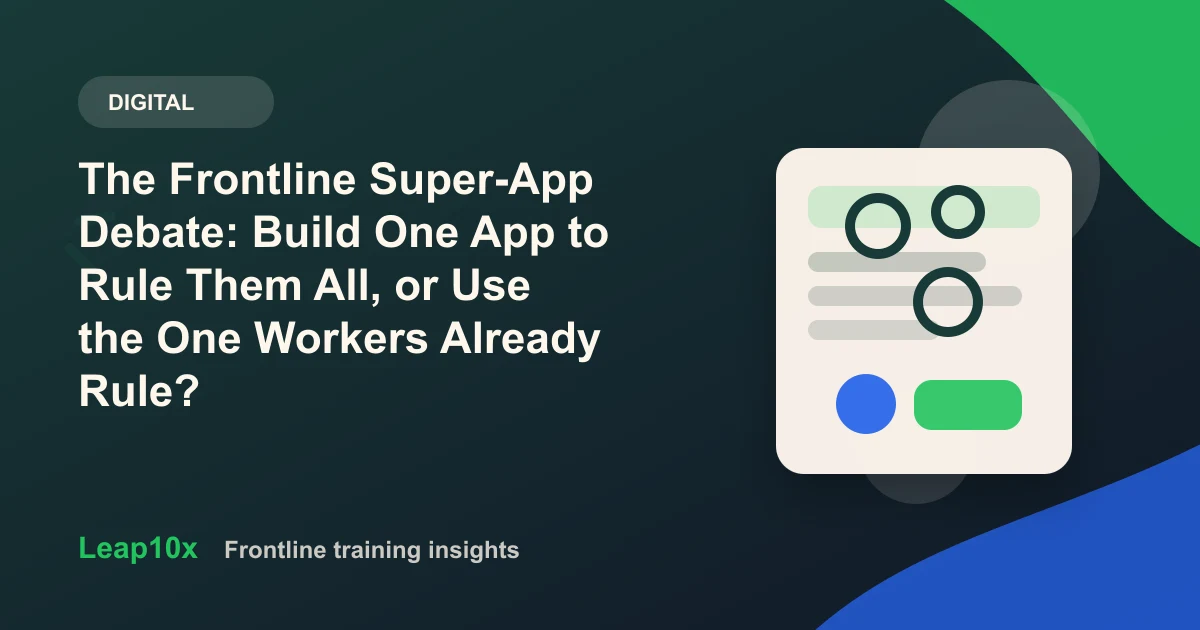
Once a company admits it has too many workplace apps, the next meeting produces two competing dreams.
Dream one: the super-app. One beautiful employer app - shifts, pay, training, comms, recognition, everything - replacing the sprawl. The consumer analogy is seductive: if WeChat and Paytm can be everything-apps, why can't we?
Dream two: the channel play. Skip the destination entirely and deliver everything through the messaging app with 100% existing adoption - for most frontline workforces, WhatsApp.
Both kill the sprawl. They differ on one question: who owns the container? Here's the honest comparison.
The super-app case (and its physics problem)
The appeal is real: full UI control, deep workflows (scheduling swaps, payslip breakdowns, document vaults), your brand on the home screen, and no dependency on Meta's platform rules.
The physics problem is adoption gravity. A super-app is still an app - subject to every force that killed its predecessors: install friction, login decay, notification muting, and the personal-phone veto. Consumer super-apps won by being used dozens of times daily for things people love. An employer app's natural frequency - checking a roster, opening a payslip - is a few times a week at best. Frequency is the moat, and employers structurally don't have it. The research verdict stands: only ~1 in 5 frontline workers even wants a standalone employer app.
Super-apps also carry the heaviest version of every rollout cost: multi-year build/integration, permanent UX investment, and - in high-attrition workforces - an adoption campaign that never ends because the workforce keeps being replaced.
Where it genuinely wins: operations-intense businesses (complex self-scheduling, gig marketplaces, in-app earnings) where the app is the work relationship - and workforces on company-issued devices, where the install veto disappears.
The WhatsApp channel case (and its boundary)
The channel play inverts the physics: instead of building frequency, it borrows it. The container is the app workers open 50 times a day by choice; the company delivers capabilities into it - training, comms, pulses, AI helpdesk, recognition, reporting - via the managed Business API.
What that buys, measurably: day-zero reach of ~100% including contractors, 85%+ training completion vs 20–30% on app-based stacks, zero install/password support, and deployment in days (Leap10x sets up in ~24 hours) instead of build-years - at a fraction of super-app TCO.
Its honest boundaries:
- Interaction depth: chat handles conversational-grain work brilliantly (lessons, checklists, Q&A, surveys) but not dense visual workflows - a drag-and-drop shift-swap market wants a screen, not a thread
- Platform dependency: you operate within WhatsApp's API rules, template approvals, and pricing - a real strategic consideration, mitigated by multi-channel platforms (Leap10x also delivers into Teams, Slack, SMS, and QR-linked web on Enterprise plans) and by owning your content and data exports
- Governance is on you: the channel is only as compliant as its implementation - opt-ins, logging, quiet hours done properly
The decision framework
| Question | Points to super-app | Points to WhatsApp channel |
|---|---|---|
| Company devices or BYOD? | Company-issued | BYOD (the frontline norm) |
| Core need | Deep ops workflows daily | Reach: training, comms, voice, support |
| Attrition | Low | High - re-adoption kills apps |
| Contractors/extended workforce? | Few | Many - no-HRIS enrollment matters |
| Budget & timeline | Multi-year, crores | Weeks, opex |
| Workforce languages | Few | Many - 70+ auto-translation beats UI localization |
And the pattern most large enterprises actually land on: hybrid - a lean ops app (or existing HRMS app) for the deep workflows that truly need screens, with the entire engagement, learning, and communication layer running zero-app on WhatsApp. The mistake isn't choosing either tool; it's building a super-app to solve what is fundamentally a reach problem. Reach problems are channel problems, and the channel already exists.
A one-quarter way to decide with data
Before committing super-app budget, run the cheap experiment: deliver your three highest-value frontline functions (training, announcements, helpdesk) through managed WhatsApp at two sites for 90 days. Measure reach, completion, response, and support load against your current stack. If the channel hits 90%+ reach at a fraction of the cost - the typical result - you've just discovered how much of the super-app you never needed to build. Whatever remains unmet is your actual app requirement, now precisely scoped.
Call to Action
Borrow the super-app your workers already love. Book a Leap10x demo - we'll stand up the 90-day channel experiment that tells you exactly how much app you really need to build. Request a demo →
Frontline training
Training software built for deskless teams
Onboarding, SOPs, safety refreshers, and compliance evidence for workers with no corporate email and no company device — tracked by site, role, and shift.